
Types of Drill Bits: Choose by Material and Hole Shape
Compare twist, step, brad-point, spade, Forstner, masonry and other drill bits, then match the cutter, shank and hole size to your workshop job.
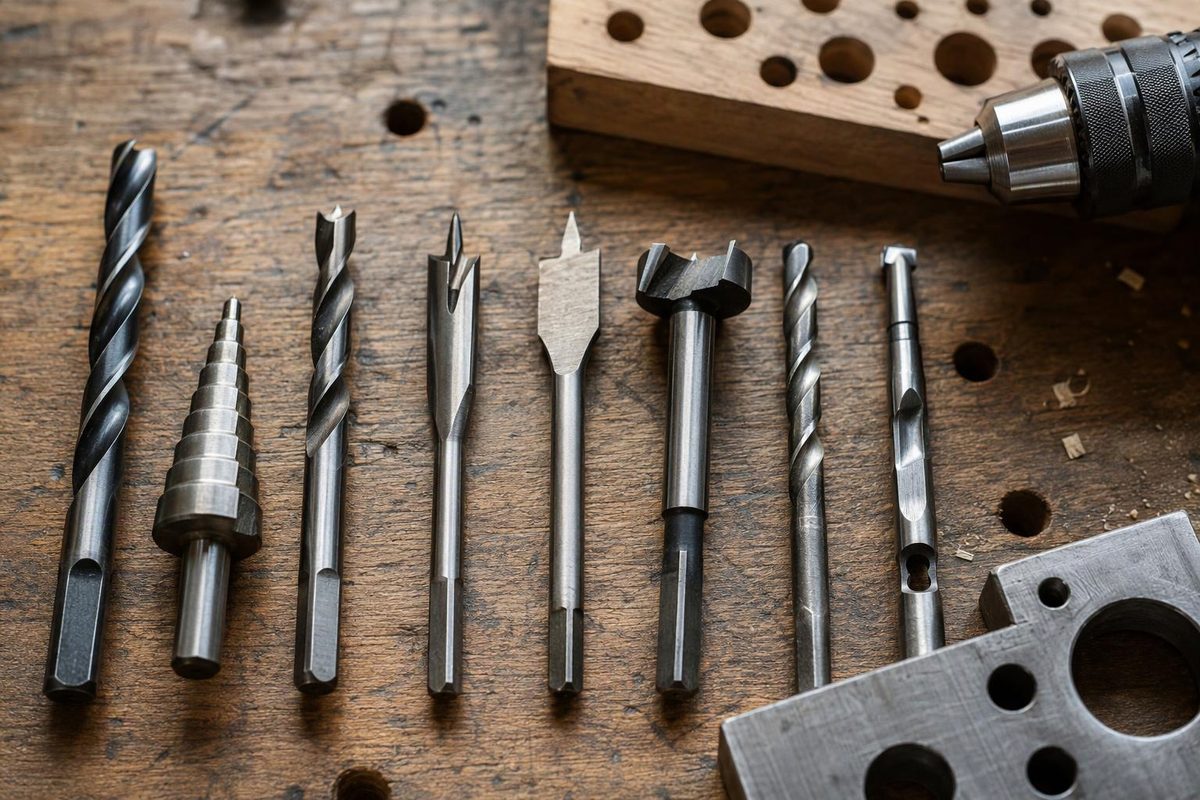
For an ordinary hole through a steel bracket, start with a metal-cutting twist drill. For an opening in thin sheet, consider a step drill. For a flat-bottomed recess in a wooden machine base, choose a Forstner bit.
Those are cutting shapes. HSS, cobalt HSS and carbide describe tool materials; titanium nitride describes a coating. Match the shape to the hole and the bit’s application rating to the stock. Then check that it suits the drilling setup.
Common drill-bit types and when to use them
Hole saws and annular cutters belong in this comparison because they solve the same hole-making task, even though they cut around a core rather than turning the entire hole into chips.
| Type | How to recognize it | Choose it for | Selection checkpoint |
|---|---|---|---|
| Twist drill | Spiral flutes and a pointed cutting end | Ordinary through or blind holes in metal; suitable versions also drill wood and plastic | Match the point, tool material and usable length to the stock. The flutes carry chips out of the hole. RUKO guide. |
| Step drill | A cone made of distinct, increasing-diameter steps | Drilling or enlarging holes in thin sheet metal and suitable plastics | Confirm that the required diameter is present and the bit’s thickness rating covers the work. Stop before entering the next size. Steelmax guide. |
| Brad-point drill | A sharp central spur with cutting spurs at the outside | Located holes in wood, such as dowel holes and mounting holes in wooden bases | The center point locates the start; outer spurs help reduce splintering. Still check the finished fit. IRWIN specifications. |
| Wood spade bit | A flat paddle with a center point | General wood boring when a flat-bottomed recess is not required | Buy a wood-rated bit and check its diameter and reach. IRWIN range. |
| Auger bit | A pronounced spiral, commonly with a threaded screw point | Boring through timber, including jobs needing longer reach | Check usable drilling length. The screw-point and spur design are intended for wood. IRWIN specifications. |
| Forstner bit | A broad cutting head with a circular rim and center point | Clean, flat-bottomed blind holes and recesses in wood | Set the required depth before drilling; choose this for the recess shape rather than simply for a large diameter. IRWIN specifications. |
| Hole saw | A toothed cup, usually on an arbor with a pilot drill | Larger through-openings in panels, wood, plastic or metal, using the appropriate saw | Match tooth material, cutting depth, arbor and speed to the job. Bi-metal versions cover many wood, plastic and metal applications. Starrett guidance. |
| Annular cutter | A hollow, fluted metal cutter | Through-holes in metal using a compatible magnetic drill or other approved machine setup | Match shank, pilot and rated cutting depth. It cuts the hole’s perimeter and leaves a central slug. Hougen guide. |
| Masonry or concrete bit | A carbide cutting insert at the tip | Holes in brick, masonry or concrete, according to the bit’s rating | Match the material, machine and operating mode. SDS-plus and SDS-max identify rotary-hammer shank systems, not hole diameters. BAER guide. |
| Diamond tile bit | A diamond-abrasive cutting surface rather than ordinary cutting lips | Hard tile and porcelain stoneware | Select a bit expressly rated for the tile; follow its wet/dry and tool requirements. BAER guide. |
A step drill’s limit is especially easy to overlook. Different designs have different step lengths and thickness ratings: RUKO’s longer-step design, for example, extends its stated capacity beyond ordinary sheet-metal applications. Do not apply one bit’s rating to every stepped cone. See the manufacturer’s explanation and our step-drill selection guide.
HSS, cobalt, carbide and coatings are separate choices
For general garage metalwork, HSS—high-speed steel—is a practical starting point, particularly for ordinary steel and non-ferrous metals. Cobalt HSS is worth considering for stainless and other demanding alloys: it contains cobalt for improved heat resistance. It is not simply a surface coating. RUKO’s material descriptions explain these distinctions.
Solid carbide serves demanding, high-speed or precision machining applications. Carbide-tipped tools combine carbide cutting edges with a steel body. Neither label alone tells you whether the tool is for metal, concrete or another material; its geometry and application rating still matter. Check the machine requirements rather than treating carbide as a universal upgrade. MSC’s material guide distinguishes solid-carbide and carbide-tipped construction.
A “titanium” drill bit may be HSS with a titanium-nitride coating, not a bit made from titanium. Read the actual marking and material rating; coating names do not replace cutter selection. RUKO’s coating descriptions explain the HSS-TiN designation.
Match the hole and setup before cutting
- Specify what the hole does. A screw pilot, bolt clearance hole, tap-drill hole and flat-head screw seat are different features. Choose the required diameter from the drawing or fastener guidance—not from the screw’s nominal name. Use the drill-and-tap guide chart when preparing a threaded hole.
- Check the tool connection and reach. Confirm chuck or arbor compatibility, usable cutting length and space beyond a through-hole. For an annular cutter, follow the dedicated mag-drill shank, pilot and depth guide.
- Secure the part and use the specified speed. On a drill press, clamp the work or use a drill vise, wear eye protection, remove the chuck key and do not wear gloves. Reduce pressure as a twist drill breaks through. These are CCOHS drill-press precautions.
- Verify the finished feature. Wait until the machine is completely stopped before measuring. Remove burrs, check diameter and location, and trial-fit the intended hardware where appropriate. The diameter stamped on the cutter is a selection target—not verification that the finished hole meets the drawing.