
High Speed Steel Step Drill Bit: Sizes and Thickness Limits
Choose an HSS step drill for thin sheet, check its diameter sequence and thickness limit, and enlarge holes without cutting into the next size.
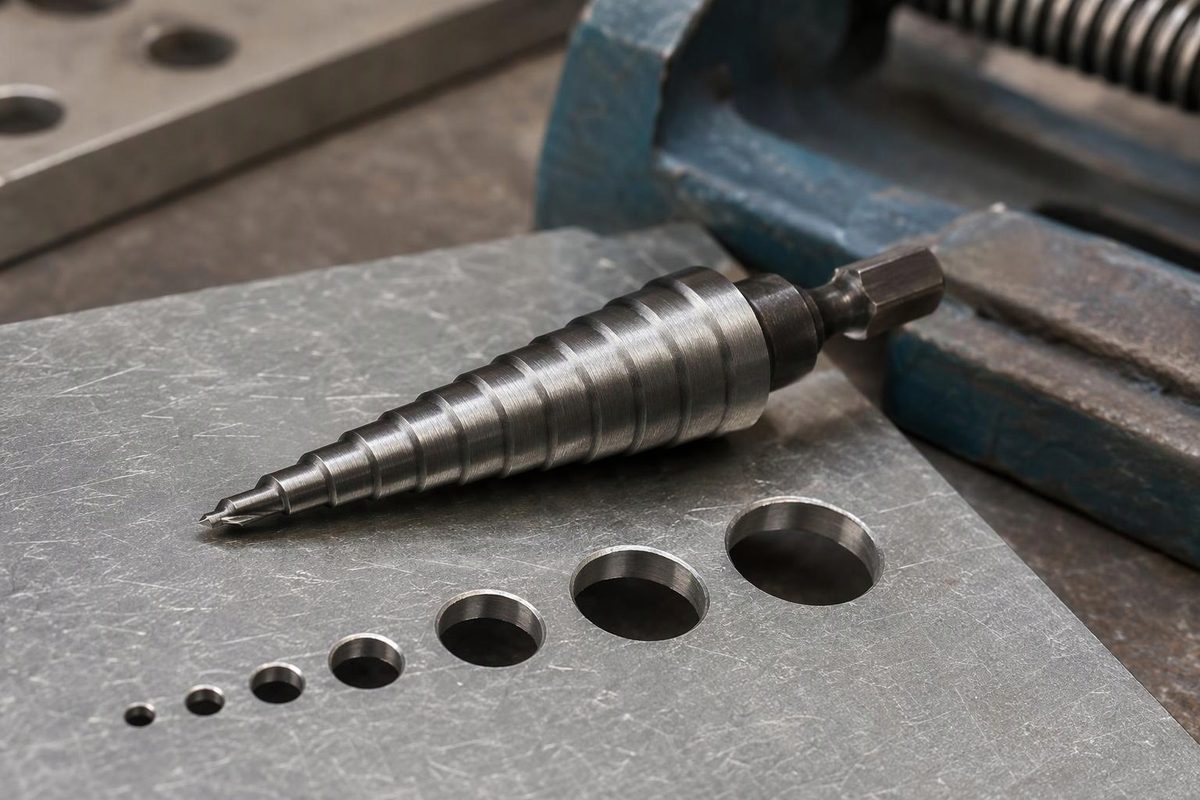
A high speed steel step drill bit is useful for making or enlarging holes in thin sheet—not for drilling a deep, constant-diameter hole through plate. Its stepped profile lets one tool cut several specified diameters. 3keego’s step-drill guide describes applications in thin sheet metal and plastic. HSS means high-speed steel; the material label alone does not tell you which diameters it cuts or how thick the work can be.
For a cover panel, light bracket or enclosure, choose the bit by the required finished diameter, the sheet thickness and the exact tool’s material rating.
Read the whole diameter sequence
A range such as “6–20 mm” does not mean the bit cuts every diameter between those limits. Check the listed steps before buying.
For example, RUKO’s 101 651 P HSS step drill lists 6, 8, 10, 12, 14, 16, 18 and 20 mm. It has a 12 mm step but no 13 mm step. Those are specifications for that particular model, not a standard sequence for all step drills. RUKO’s diameter table shows several different ranges and increments.
Do not stop partway down the sloping transition to obtain an unlisted size. That transition does not provide a constant-diameter cutting section through the sheet. If the drawing calls for an intermediate diameter, choose another cutter. The drill diameter chart can help identify a conventional drill size.
Also check the smallest step and starting-point design. Some step drills start a new hole themselves; larger designs may require a pilot hole. Follow the instructions for the selected bit rather than assuming every stepped tool is self-starting. 3keego’s starting-hole instructions distinguish these cases.
Thickness is limited by the individual step
Two dimensions matter:
- Diameter increment: the difference between successive hole sizes.
- Step depth: the axial length available at one diameter before the next larger cutting transition.
The second dimension limits the thickness you can drill at that size. 3keego’s step-drill instructions specify work thinner than the step depth.
The geometry explains why: the selected diameter must pass through the bottom face before the next larger step cuts the top face. If the sheet is too thick, advancing the bit far enough to finish the bottom enlarges the entrance first.
There is no universal thickness limit for an HSS step drill. Use the manufacturer’s maximum material thickness, and check any size-specific restrictions. Overall bit length is not usable drilling depth. If the thickness rating is missing, do not assume that a large diameter range makes the tool suitable for thick stock.
A backing board also does not extend the bit’s thickness capacity. Allow clearance beneath the sheet for the smaller steps and tip; check that they cannot hit the drill table or hidden components.
Drill or enlarge the hole in controlled stages
- Measure and mark. Confirm sheet thickness, hole location and target diameter. Identify the target step while the bit is stationary. For an existing hole, measure it first and check that the bit has smaller steps that can enter it.
- Support and clamp the sheet. Keep it flat and secure against spinning; do not hold a small panel in your hand. Wear eye protection, secure loose clothing and keep gloves away from the rotating tool. Fit the bit with the power disconnected. On a drill press, use the guards and remove the chuck key before starting. These precautions align with the Construction Safety Association of Manitoba’s drill-press procedure and 3keego’s preparation guidance.
- Prepare the start. Use a center mark or pilot hole if the tool requires one. When enlarging, align the bit squarely with the existing hole; do not lean it sideways to move the hole’s center.
- Cut at the recommended speed. Use the maker’s speed guidance for the material and diameter, with suitable cutting fluid for metal. Feed steadily, then reduce pressure as you approach the target. 3keego recommends low speed, steady pressure and reduced force near the final size.
- Stop before the next size engages. Let the target step finish through the sheet, then withdraw. On a drill press, a depth stop checked on matching scrap can help control repeated holes.
Check the finished part, not just the marking
With the tool stopped, remove burrs from both faces and check the hole across more than one direction. Verify fit with the intended fastener, bush or grommet as appropriate; insertion alone does not establish a close dimensional tolerance.
The next step’s bevel can lightly deburr an edge, but feeding farther risks cutting the next diameter. For a controlled screw-head seat, use a countersink matched to the screw, not an assumed angle on the step drill.
If the required diameter is absent, the stock exceeds the thickness rating, or the hole needs a close-tolerance cylindrical finish, choose a different drilling or finishing method before cutting the actual part.