
Tungsten Carbide Drill Bits: Match the Tool to the Setup
Choose solid-carbide or carbide-tipped drills for garage metalwork, check machine rigidity, and avoid spotting and coolant mistakes that chip the edges.
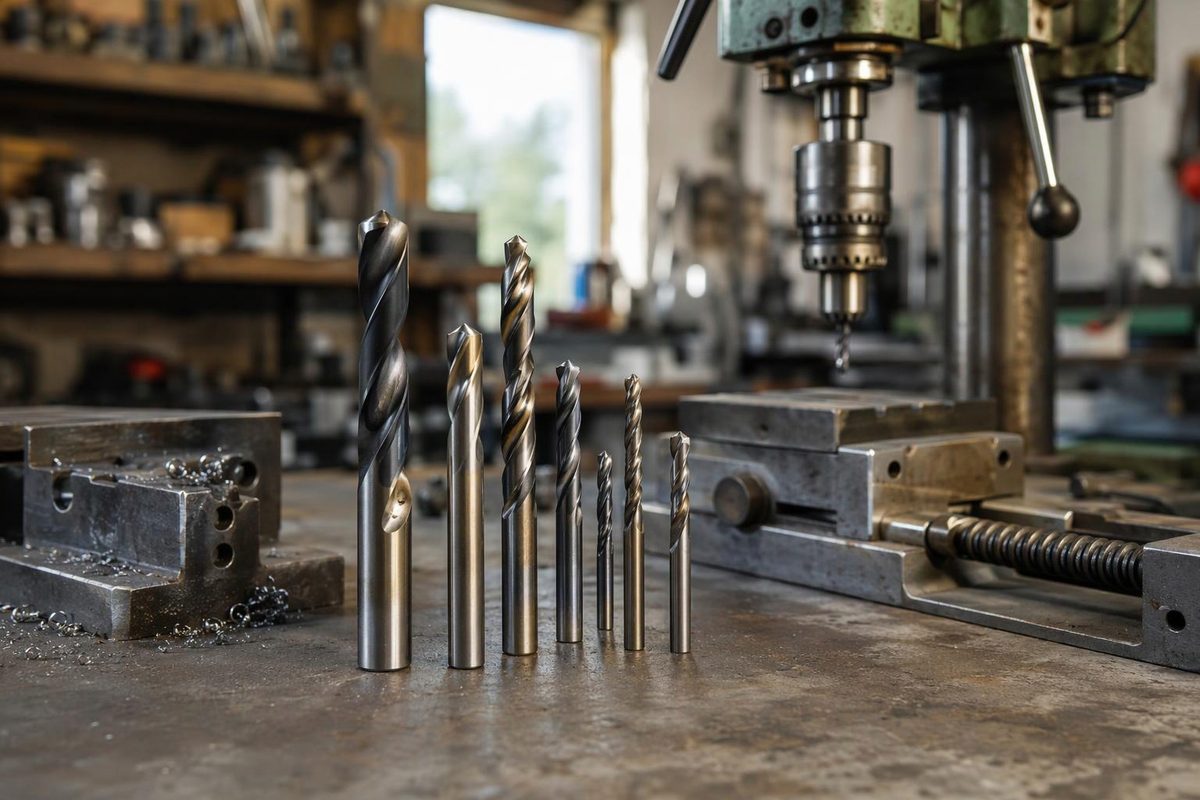
Tungsten carbide drill bits are not a universal upgrade for a hand drill. For metalwork, choose them when the material or repeated drilling justifies their wear resistance—and when the machine, holder and workpiece can stay stable. Solid carbide can chip or break when runout, movement or trapped chips overload it; Sandvik lists all three among its solid-carbide drilling failure causes.
For a few clearance holes in an ordinary mild-steel bracket, first consider an HSS drill. For tougher metalwork, compare a cobalt HSS drill before assuming carbide will solve the problem.
Identify what “carbide” means
The label covers different constructions and applications:
- Solid-carbide metal drill: the tool body is cemented carbide, rather than a steel body carrying a carbide cutting tip. Cemented carbide is a composite of tungsten carbide particles and a cobalt-rich binder—not pure tungsten. Grain size and binder content affect its hardness and toughness. A coating is a separate feature, not what makes the drill carbide. See Sandvik’s cutting-tool material definitions.
- Carbide-tipped metal drill: carbide cutting edges are attached to a steel body. Hannibal explains that its carbide-tipped construction uses a tough alloy-steel body to absorb shock loads. That does not remove the need for a stable setup. Hardened-steel work needs a tool specifically intended for it, such as a hard-steel die drill, not merely any tipped drill.
- Carbide masonry drill: a different tool application. For example, DeWalt’s SDS MAX masonry drill has a carbide head and is designed for reinforced concrete. “Carbide” alone does not establish suitability for machining a steel bracket.
Before buying, match the exact drill series to the workpiece alloy, heat-treatment condition, hole diameter and depth. Do not assume every carbide metal drill is rated for hardened steel.
Decide whether your machine is suitable
For garage work, treat solid carbide as a machine-setup decision, not just a material decision. Prefer a rigid, clamped machine setup over an unsupported hand drill. A drill press is not automatically unsuitable, but its spindle condition, chuck accuracy, quill play and workholding matter; a milling machine still needs those checks.
Sandvik recommends the shortest practical drill, a rigid and accurate holder with minimum runout, a well-aligned spindle and a stable component.
Check these before cutting:
- Secure the part. Clamp it so it cannot rotate, lift or slide. Support thin stock close to the hole.
- Minimize reach. Choose enough usable drilling depth without unnecessary tool overhang.
- Check toolholding. Clean the shank and holder, seat the drill correctly, and check radial runout against the drill maker’s requirement. Visible wobble is a reason to stop, not compensate with more pressure.
- Read the cutting data. Use the exact series’ speed, feed, coolant and drilling-cycle recommendations. There is no single “carbide RPM” for every diameter and material.
Wear appropriate eye and face protection, remove the chuck key and do not wear gloves while operating a drill press. Keep guards in place. Stop the machine completely before measuring or clearing chips; use a brush rather than your fingers. These are basic drill-press safety practices.
Do not automatically add a pilot hole
A shallow spot locates the drill’s entry; a pilot hole can also support a longer drill. They are not interchangeable preparations.
Many modern solid-carbide drills are self-centering and do not need a starter hole on a suitable flat surface, according to the toolmakers interviewed in Cutting Tool Engineering’s spotting guide. Deep-hole tools may require a carefully specified pilot instead. Follow the drill’s instructions rather than stepping through progressively larger bits by habit.
If spotting is required, choose the spot angle to suit the carbide drill. Guhring recommends a 142° spot drill for carbide drills with 135–140° points: the drill point enters first, rather than the fragile outer corners. Its spotting recommendations warn of corner crumbling when those corners contact first. A convenient 90° spot is therefore not a universal choice.
Control chips, then verify the hole
Coolant delivery is part of tool selection. Sandvik prefers internal coolant, particularly for long-chipping materials and holes deeper than three drill diameters. External coolant can work for shallow holes with good chip formation. A through-coolant drill does not mean your machine can supply the flow it needs; check the coolant requirements before ordering.
If the cutting sound becomes irregular, chips pack in the flutes or the edges chip, stop and inspect the setup. Do not simply push harder. Reduce drilling pressure as the bit breaks through, as advised by CCOHS.
After drilling, stop the spindle, clear chips and deburr before checking diameter, location and fit. The drill diameter chart gives nominal tool sizes; it does not certify the finished hole. Verify a tap-drill, clearance hole or precision fit against the drawing before committing to the next operation.