
7 Records to Keep Before Ordering a Replacement Part
Keep seven records for an unknown replacement part, including markings, measurement locations, instrument checks and the proposed supplier match.
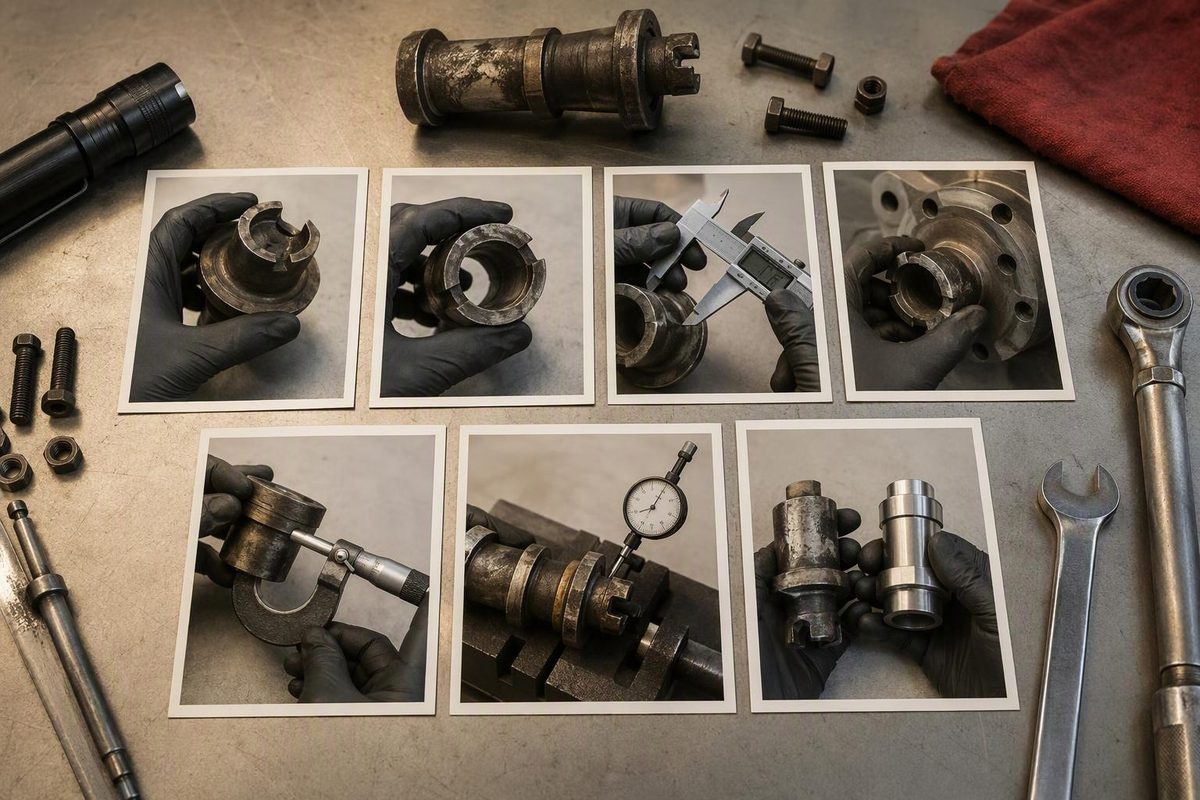
Make the part identifiable twice
A replacement enquiry should let someone else identify the same item without guessing what your photograph or number means. Collect these seven records before choosing a catalogue match. This is an editorial documentation checklist, not a substitute for a manufacturer’s part number or assembly specification.
1. Where the part came from
Record the machine or project identifier and the part’s location. If the item was already detached, say so. Do not recreate a position from memory as though it were documented. A photograph of the labelled storage bag can preserve the connection between the loose item and its notes.
2. Every marking you can actually read
Copy numbers, letters and logos exactly, including spaces or suffixes. Photograph them separately. Use a question mark for an uncertain character rather than silently converting it to a plausible catalogue number. Keep your proposed interpretation in another field.
3. An orientation sketch
Draw a simple view and label the ends A and B. Mark the face used as the reference for each length. The sketch does not need drafting polish; it needs to prevent “length” from meaning overall length in one note and shoulder length in another.
4. Measurements with units and locations
Write the reading, units, feature and measurement position together: “Outside diameter near end A, 18.02 mm,” for example. That number is hypothetical. Avoid a list of dimensions that depends on your remembering which reading belongs to which feature.
5. The instrument and checks
Record the tool identifier, measurement mode and whether you checked its zero. Mitutoyo’s caliper guidance recommends checking closure at zero before taking measurements. That check concerns the starting indication; it does not establish accuracy across the instrument’s range. Mitutoyo: Caliper measuring technique.
If the required fit is tighter than your measurement method can resolve with confidence, label the dimension provisional. Do not add decimal places to make an uncertain measurement look finished.
6. Visible condition and unknown properties
Photograph damage, coatings and worn areas. Record material as unknown unless documentation or suitable identification supports it. Colour and appearance are useful descriptions, but leave material grade, heat treatment and load capacity as separate unanswered questions.
7. The source of the proposed match
Save the supplier drawing, exact product designation and revision or access date. Separate “measured on old part” from “specified for replacement.” If a drawing dimension differs from your reading, preserve both and ask what explains the difference before ordering.
Send a question someone can answer
Finish the packet with the unresolved decision: “Does this drawing identify the part, and which dimensions need a better measurement?” is clearer than “Will this fit?” Keep the old part, notes and supplier response linked by one identifier. A catalogue resemblance is a lead; an approved replacement still needs the relevant specification and application checks.
If the markings identify a hex-head fastener, move from this general record to the specific diameter, pitch and length checks for a hex head screw.