
Grade 8 Bolts: Identification, Strength and Proper Uses
Identify SAE Grade 8 bolts by six radial head marks, understand their 150,000 psi tensile strength, and check when they suit a garage-built joint.
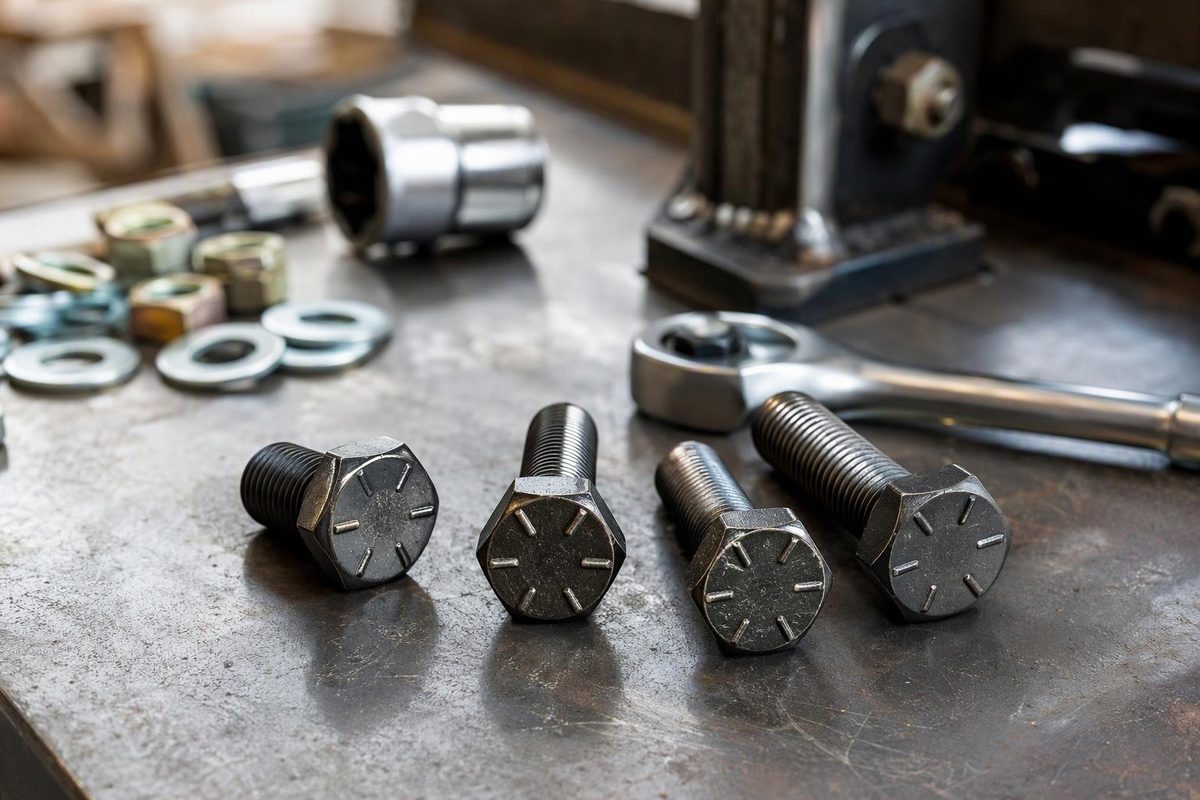
SAE Grade 8 bolts are high-strength, inch-series fasteners made from quenched-and-tempered medium-carbon alloy steel. Their minimum tensile strength is 150,000 psi for nominal diameters from 1/4 through 1-1/2 inches. Grade 8 describes material and mechanical requirements under SAE J429—not the bolt’s diameter, thread pitch or wrench size. Fastenal’s fastener reference guide lists the material and strength requirements.
For a garage builder, the useful question is not simply whether Grade 8 is stronger. It is whether the bolt, mating threads and surrounding material suit the joint.
How to identify a Grade 8 bolt
On a conventional Grade 8 hex-head bolt or cap screw, look for six radial lines, spaced around the head like short spokes. There should also be a manufacturer’s identification mark. Fastenal’s Grade 8 product standard explicitly requires the manufacturer’s ID and six lines spaced 60 degrees apart.
Two common identification traps:
- Yellow plating is not the grade mark. Nucor’s product data lists Grade 8 cap screws in both plain/black and zinc-with-yellow-chromate finishes. Identify the grade from the markings and supplier specification, not color.
- Metric class 8.8 is not SAE Grade 8. Metric bolts use a different property-class system, commonly shown as numbers on the head. Class 8.8 has lower specified tensile strength than SAE Grade 8; the similar-looking designation does not make the bolts interchangeable. Bolt Depot’s grade chart
Clean a dirty head enough to read it. If the marks are missing, damaged or ambiguous, treat the grade as unverified rather than guessing from appearance. For a consequential joint, buy identified fasteners from a supplier that can provide lot-linked material and test documentation.
What the strength numbers mean
For SAE Grade 8 bolts from 1/4 through 1-1/2 inches:
| Property | Specified value | Practical meaning |
|---|---|---|
| Proof stress | 120,000 psi | Stress corresponding to the axial proof load the bolt must withstand without permanent set |
| Minimum yield strength | 130,000 psi | Strength associated with a specified amount of permanent deformation |
| Minimum tensile strength | 150,000 psi | Minimum required ultimate tensile strength—not a working-load rating |
Values come from Portland Bolt’s J429 table; the terminology is explained in Bolt Depot’s chart.
These are stress values, not pounds a bolt can safely hold. Tensile load capacity depends on the threaded stress area, which depends on diameter and pitch. The joint also needs an appropriate design margin and checks for its actual loading. Fastenal’s bolted-joint guide explains that relationship.
For comparison, Grade 5 bolts from 1/4 through 1 inch have a minimum tensile strength of 120,000 psi. Grade 8’s 150,000 psi is 25% higher, but that does not establish a 25% increase in the capacity of an assembled joint.
When Grade 8 is appropriate
Grade 8 is a candidate for high-strength automotive and machinery joints where the equipment specification or joint design calls for it. It is not an automatic upgrade for every bracket or frame connection.
A stronger bolt cannot prevent surrounding material from being damaged or warping under excessive clamp force. Repeated loading can also cause fatigue failure below the material’s ultimate strength. Both effects are covered in Fastenal’s joint-design guide.
Before ordering, check:
- The required grade and standard. For repairs, preserve the equipment maker’s specified fastener rather than substituting solely on strength.
- Diameter, pitch, length and grip. Grade alone does not define fit. In a joint designed to carry shear through the bolt body, choose the grip so the smooth shank—not the threads—crosses the shear plane. Fastenal’s guide explains the strength advantage of keeping the shank in the shear plane.
- Mating hardware. Fastenal lists SAE J995 Grade 8 hex nuts as compatible with SAE J429 Grade 8 bolts. Do not pair a high-strength bolt with an unidentified nut simply because it threads on. Fastener reference guide
- Finish and service environment. Corrosion, temperature, vibration and fatigue belong in the selection decision, not just tensile strength.
Finally, Grade 8 does not supply one universal torque setting. Use the equipment or joint specification and its stated assembly conditions. For tightening practice rather than grade selection, see bolt torque basics.