
Drill Bit Extender: Match the Shank, Lock and Reach
Choose a drill bit extender by shank, retention, usable reach and coupling clearance—and know when a longer drill bit is the better choice.
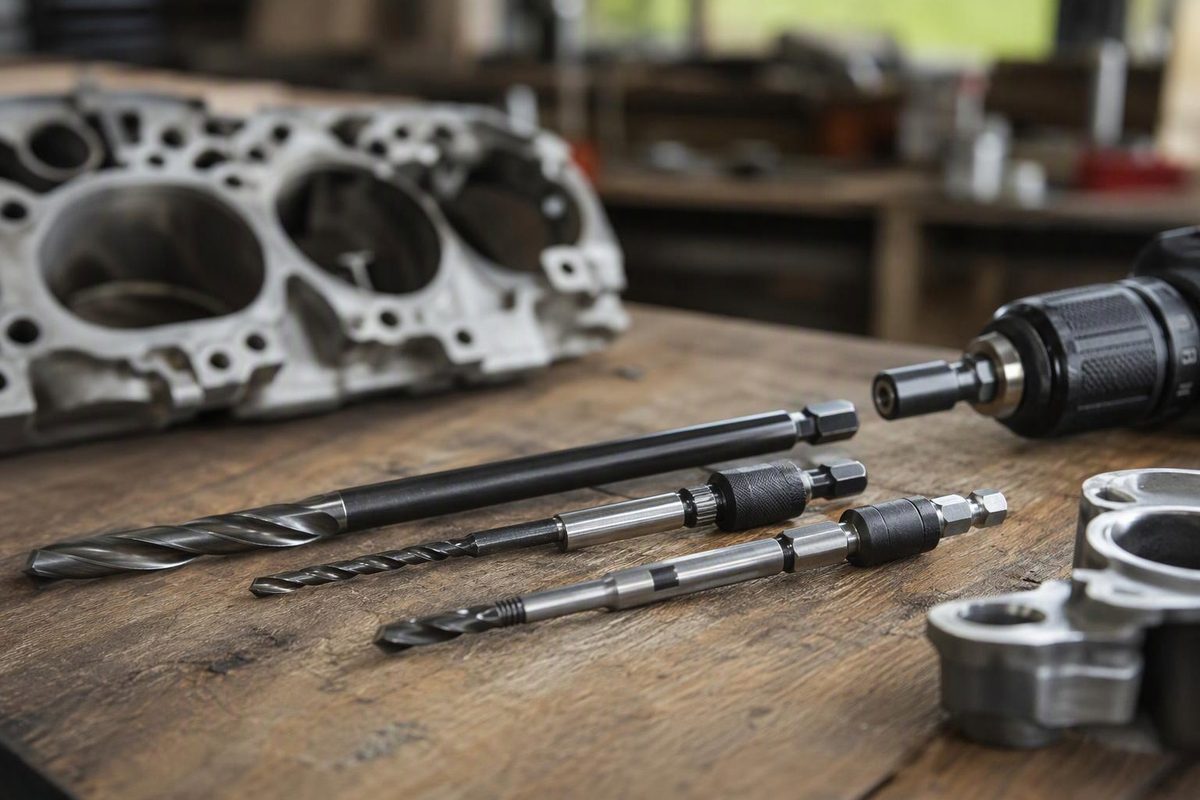
A drill bit extender adds reach between the drill chuck and a compatible bit. Choose it by the bit’s shank—not the hole diameter—then check that the coupling can clear every obstruction along the drilling path.
For a recessed bracket or a hole behind a frame member, those are separate checks: the cutter may reach the mark while the extension’s collar still strikes the frame. An extender also does not lengthen the bit’s flutes or turn a shallow cutter into a deep-hole drill.
Match both ends before buying
Identify the bit’s shank shape, size and any retention groove. For a hex shank, measure across opposite flats. Then check the extension’s input shank against your drill’s chuck capacity or quick-change interface.
| Bit you need to extend | What to look for |
|---|---|
| 1/4-inch hex-shank drilling bit | A drilling-rated 1/4-inch hex extension with a compatible locking mechanism. Diablo’s DXT1010 is one example of a 6-inch, 1/4-inch hex quick-change extension. |
| 7/16-inch hex auger, self-feed bit or hole-saw arbor | An extension specifically accepting 7/16-inch shanks; also check the drill-side chuck requirement and any minimum cutter diameter. |
| Round-shank twist drill | A holder explicitly specified for that round-shank diameter, or a longer drill bit. Do not assume a hex-bit extension will clamp it. |
| Flexible installer bit | The matching flex-bit extension system, including its shank and connection-diameter limits—not a generic flexible screwdriver shaft. |
Diablo specifies the DXT1010 for handheld drilling and tool-free accessory changes. For the larger interface, Milwaukee’s 48-28-4001 accepts 7/16-inch hex shanks and uses hex-key tightening. Milwaukee lists it for self-feed bits, auger bits and hole saws 1 inch in diameter and larger with that shank. It requires a three-jaw chuck of 1/2-inch capacity or larger, or a compatible 7/16-inch quick-change chuck.
“Universal” is not a promise that every drill bit fits. Read the stated shank interface. Likewise, a hex extension is not an SDS extension merely because an adapter could connect it to the tool.
If the job is reaching a socket-head screw rather than cutting a hole, use the separate guidance on hex driver-bit selection.
Check retention, not just insertion
A bit that slides into the socket has not necessarily locked into it. Check whether the holder accepts your shank’s groove arrangement and whether it is intended for drilling.
For example, Milwaukee’s 7/16-inch Universal QUIK-LOK extension is specifically described as accepting shanks with or without a power groove. Do not transfer that compatibility to another holder.
For drilling, choose a mechanical lock rather than relying on a magnet alone. With power disconnected, fully seat the bit, engage the collar or tighten the locking screws as instructed, then pull on the bit to confirm retention. Make sure you can operate the release after withdrawing the assembly.
If using an impact driver, verify that both extension and bit are approved for it. An impact-rated extension does not make an unrated cutter suitable, nor does that rating establish approval for rotary-hammer operation.
Measure usable reach and coupling clearance
For a straight drilling path, choose the shortest single rigid extension that clears the obstruction. Avoid stacking holders as the default solution: each extra joint adds another fit and alignment checkpoint.
Before switching on, check:
- Assembled reach: Measure from the chuck nose to the cutting tip with both shanks fully seated. Do not simply add the advertised bit and extension lengths; inserted portions overlap.
- Coupling clearance: Measure the largest outside diameter of the socket, collar or screw housing. Check it against the access opening and any hole it must enter.
- Full drilling travel: Allow for the drill’s advance to the intended final depth, not just first contact. The collar must remain clear throughout that travel.
- Cutting depth: Check the cutter’s specified depth capacity. For a twist drill, check usable flute length against material thickness and planned depth; the extension contributes no cutting flutes.
The difference between shank size and coupling size can be substantial. Klein’s 53722 flex-bit extension has a 1/4-inch shank but a 5/8-inch connection diameter; Klein specifies it for flex bits 3/4 inch and larger. That is a system-specific limit, not a general clearance rule.
Assemble, check alignment, then drill
Wear safety glasses and follow the drill and extension manufacturers’ instructions.
- Disconnect power, clean the mating surfaces and inspect for damage or bending.
- Seat and lock both connections. Remove any chuck key or tightening key.
- Clamp the workpiece. Check that the tool can stay aligned with the intended hole throughout its travel.
- With the cutter clear of the work and hands clear of the rotating assembly, briefly run at low speed. Stop if the tip visibly orbits or the assembly vibrates; disconnect power before correcting it.
- Drill without using sideways pressure to steer around an obstruction. Reduce feed as the bit breaks through.
CCOHS drill guidance calls for securely seated attachments that turn true, secured work and no bent bits. It also recommends an auxiliary handle for large-scale work or continuous operation. If the bit jams, stop and disconnect power rather than repeatedly pulsing the trigger.
For a small, accurately located hole in metal, prefer a suitable longer twist drill or reposition the work when practical—especially if the extender shows wobble or its coupling cannot clear the opening. Reaching the mark is only the setup check; verify the finished hole’s position and size before tapping or assembling the joint.