
5/16-18 Tap Drill Size: Use a Letter F Bit
Use a letter F drill (0.2570 in.) for a 5/16-18 cutting tap. Compare 6.5 mm and fractional alternatives, then check hole depth and finished fit.
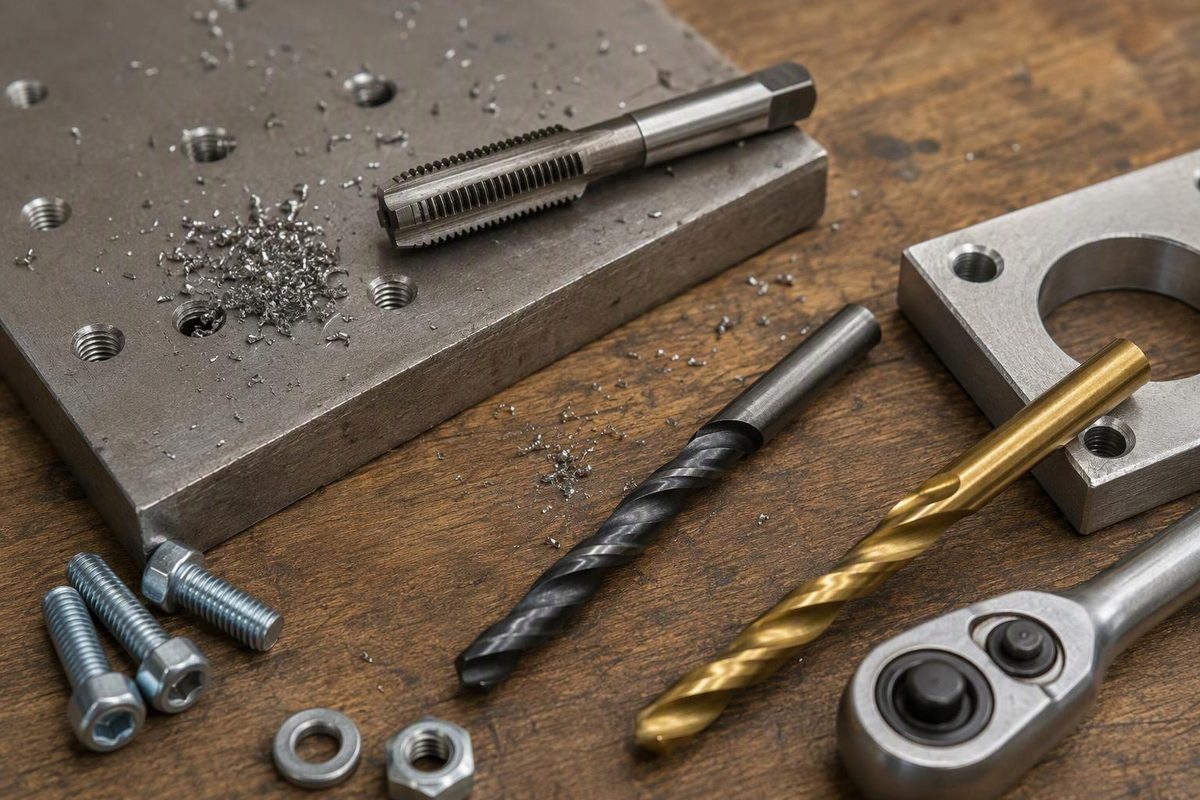
For a standard 5/16-18 UNC cutting tap, use a letter F drill bit: 0.2570 inch, or about 6.53 mm. Guhring lists this pairing in its tap-drill chart for approximately 75% thread. The recommendation is for cutting taps—not roll/form taps. Follow your tap maker’s specific hole recommendation if it differs from the general chart. Guhring tap-drill chart
The tap marking means 5/16-inch nominal thread diameter and 18 threads per inch. Do not drill a 5/16-inch hole for this thread: the tap-drill hole must be smaller so the cutting tap has material left to make the threads. A hole that lets the bolt pass through freely is a clearance hole, a different job.
What if your drill set has no letter F?
These nearby sizes are not interchangeable:
| Drill bit | Nominal diameter | Difference from F | Shop decision |
|---|---|---|---|
| Letter F | 0.2570 in. | — | Standard chart choice |
| 6.5 mm | 0.2559 in. | About 0.0011 in. smaller | Close metric candidate; verify against the tap maker’s hole limits |
| 1/4 in. | 0.2500 in. | 0.0070 in. smaller | Not an equivalent substitute; leaves more material for the tap to cut |
| 17/64 in. | 0.265625 in. | About 0.0086 in. larger | Produces shallower threads than F; do not substitute blindly |
The nominal sizes appear in Guhring’s drill chart. The 17/64-inch decimal is calculated directly from the fraction; the differences above are calculated from the nominal diameters.
17/64 inch does appear beside 5/16-18 in some charts, including Bolt Depot’s table, which also lists F. That does not make the two drill diameters equal. The larger hole leaves less thread depth. For a new garage-shop job without a specific alternative called out, buy or use the F bit rather than treating the nearest fraction as an exact replacement. Bolt Depot tap-drill table
An undersized hole is not automatically better: Guhring identifies a too-small tapping hole as a cause of tapping problems. Do not force a tap through a 1/4-inch hole simply because that bit was already in the chuck. Guhring troubleshooting guide
Check the tap type before drilling
A forming or roll tap needs a larger starting hole than the F hole used for a cutting tap. For example, OSG’s forming-tap chart lists 7.18–7.29 mm for its 5/16-18 entry. Treat that as a manufacturer-specific example, not a universal forming-tap specification; use the hole limits supplied for your actual tap and material. OSG forming-tap chart
Also verify that the tool says 5/16-18, not 5/16-24. The latter is a different pitch with a different tap drill. For other thread markings, use the drill and tap guide chart.
Drill, tap and check the finished part
- Clamp the stock securely. Locate the hole and drill square to the intended surface.
- Check the drilled hole. The bit marking is a nominal size, not proof of the finished diameter. Remove chips and lightly chamfer the entrance.
- Allow extra depth in a blind hole. Plan room for the tap’s lead, chips and the drill point below the required full-thread depth. Do not run the tap into the bottom.
- Start the tap straight, using a guide where practical and a lubricant suitable for the material. Stop if resistance rises sharply; check alignment, chip packing and remaining depth instead of adding force.
Guhring’s troubleshooting guidance specifically flags alignment, lubrication, chip congestion, entrance chamfer and bottom contact as possible problems. Tapping troubleshooting
After cleaning the thread, try a known-good 5/16-18 bolt by hand and confirm usable depth. That is a practical fit check, not verification of thread tolerance or load capacity. Where the drawing specifies a thread class, use the appropriate thread gauges before accepting the part.