
What Size Drill Bit for a 1/2-13 Tap?
A 27/64-inch drill is a widely used shop-chart choice for a typical 1/2-13 cutting-tap job, often associated with roughly 75% thread.
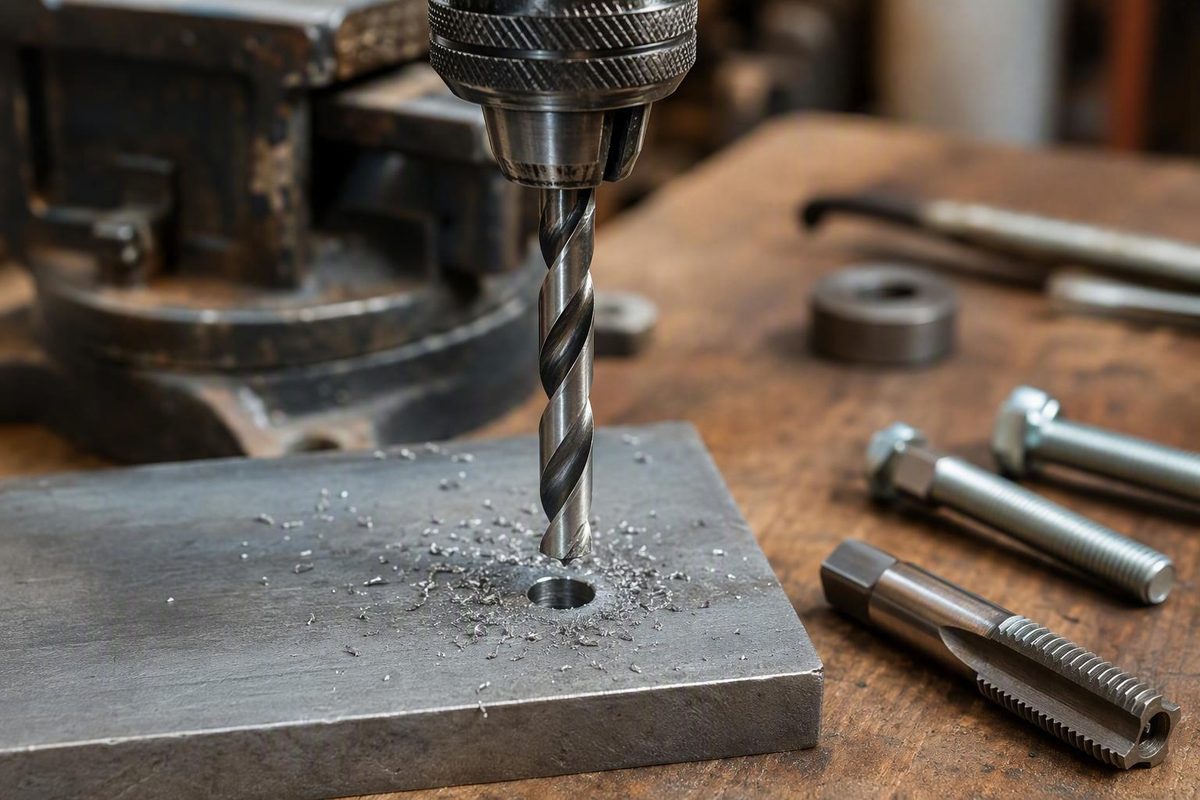
Quick answer: use a 27/64-inch drill for a typical 1/2-13 cutting tap
Quick answer
- Tap: 1/2-13 UNC conventional cutting tap
- Tap drill: 27/64 inch
- Decimal diameter: 0.4219 inch
- Metric conversion: approximately 10.72 mm
These are the common general-purpose values listed for a 1/2-13 coarse thread in the American Fastener tap-and-drill chart.
For an ordinary 1/2-13 UNC internal thread made with a conventional cutting tap, start with a 27/64-inch drill bit. Multiple shop charts converge on that selection; Newman Tools, for example, also lists 27/64 inch for approximately 75% thread in its National Coarse tap-drill table.
That is a general-purpose shop answer, not a mandatory size for every 1/2-13 hole. Use different guidance when:
- The tool is a forming or fluteless tap rather than a cutting tap.
- The drawing specifies a pilot-hole diameter or range.
- The job requires a controlled thread class or percentage of engagement.
- The manufacturer of the exact tap supplies different hole guidance.
The 27/64-inch figure is the nominal diameter marked on the drill. It does not guarantee that the finished hole will measure exactly 27/64 inch.
For straightforward shop work, the practical sequence is:
- Confirm that the thread is 1/2-13 UNC, not another 1/2-inch pitch.
- Confirm that the tool is a conventional cutting tap.
- Check the drawing and the tap manufacturer’s instructions.
- If neither specifies another size, use a 27/64-inch drill as the common starting point.
- Remember that the finished hole, rather than the marking on the drill, is the physical result that will be tapped.
Do not select a substitute merely because it looks close. A small change in diameter alters how much material remains for the tap and how much internal thread can be produced.
What 1/2-13 UNC means
The designation identifies the thread’s diameter, pitch, and series:
- 1/2 is the nominal diameter in inches.
- 13 means 13 threads per inch, commonly abbreviated TPI.
- UNC means Unified National Coarse.
Older or informal charts may use NC instead of UNC.
With 13 threads per inch, the distance from one thread to the corresponding point on the next is:
Pitch = 1 ÷ 13 ≈ 0.0769 inch
That converts to approximately 1.953 mm. This pitch distance is separate from the tap-drill diameter. A 1/2-13 thread has a nominal diameter of 0.500 inch, a pitch distance of approximately 0.0769 inch, and a common cutting-tap drill diameter of 0.4219 inch. The thread is identified as UNC in Avon Tap & Die’s imperial tapping data.
The complete designation matters because “1/2-inch thread” does not identify the pitch. A 1/2-20 UNF thread has the same nominal diameter but 20 threads per inch. Its geometry differs, so its general-purpose tap drill differs as well.
Before selecting a drill, make sure the tap, fastener, drawing, and chart agree on both values:
- Nominal diameter: 1/2 inch
- Pitch: 13 threads per inch
If the tap is marked 1/2-20 rather than 1/2-13, the 27/64-inch answer does not apply.
UNC identifies the thread series, not the way the internal thread is created. A cutting tap and a forming tap can both produce a 1/2-13 thread, but they do not necessarily start with the same hole diameter. Tap type must therefore be checked separately.
27/64 inch in decimal and metric units
The exact fractional conversion is:
27 ÷ 64 = 0.421875
Therefore, 27/64 inch equals exactly 0.421875 inch as a nominal mathematical dimension. Tap-drill charts conventionally round it to four decimal places:
0.421875arrow0.4219 inch
To convert the fraction to millimeters:
0.421875 × 25.4 = 10.715625 mm
Rounded to two decimal places, the nominal metric conversion is 10.72 mm. That same combination—27/64 inch, 0.4219 inch, and 10.72 mm—is listed in the 6G Tools tap-drill guidance.
| Expression | Nominal diameter |
|---|---|
| Fractional inch | 27/64 inch |
| Exact decimal conversion | 0.421875 inch |
| Conventional chart decimal | 0.4219 inch |
| Approximate metric conversion | 10.72 mm |
These expressions describe the same nominal diameter at different levels of rounding. They do not make every nearby metric drill an exact equivalent:
- 10.7 mm is approximately 0.0156 mm smaller than the direct conversion.
- 10.72 mm is the direct conversion rounded to two decimal places.
- 10.8 mm is approximately 0.0844 mm larger than 27/64 inch.
A 10.7 or 10.8 mm drill might be selected for a particular application, but neither is mathematically identical to a 27/64-inch drill.
This creates an important distinction between converting a nominal size and selecting a tool:
- Converting 27/64 inch produces approximately 10.72 mm.
- Selecting a metric drill means choosing an available tool that will produce an acceptable finished hole for the required tap and thread.
For an ordinary job that simply calls for the standard fractional chart size, a drill marked 27/64 avoids ambiguity. For controlled work, do not substitute a nearby metric size solely because it is convenient. Use the specified pilot-hole range or determine which tool reliably produces the required finished diameter.
Why charts mention roughly 75% thread
Tap-drill charts often relate pilot-hole diameter to an intended percentage of thread depth or engagement. In practical terms, the percentage describes how much of the theoretical thread form is intended to remain after tapping.
A smaller starting hole leaves more material around the hole for the tap to remove. A larger starting hole leaves less. The selected drill diameter is therefore part of the tradeoff between thread engagement and tapping load.
Several practical charts associate a 27/64-inch drill for 1/2-13 with approximately 75% thread. Bolt Depot, for example, lists 27/64 inch and states that its drill selections are based on 75% thread depth in its US tap-and-drill table.
That does not mean every hole drilled with a 27/64-inch bit will produce exactly 75% thread. Three different values must be kept separate:
- Nominal drill diameter — the size marked on the drill.
- Calculated target diameter — the result produced by a particular formula or percentage-depth table.
- Measured finished-hole diameter — the hole actually produced in the workpiece.
A nominal 27/64-inch drill is 0.421875 inch, but the drilled hole may not match that value exactly. A theoretical calculation can also produce a different target even when it is labeled with the same nominal percentage.
The supplied references show that discrepancy clearly. Practical charts commonly list 27/64 inch, or 0.4219 inch, for approximately 75% thread. By contrast, Machining Doctor’s theoretical table lists 0.425 inch for 75% depth in its 1/2-13 thread dimensions.
Those values are not equivalent:
0.425000-0.421875 = 0.003125 inch
The theoretical value is therefore 0.003125 inch larger than the nominal 27/64-inch drill.
The cited sources do not conclusively establish which factor—or combination of factors—causes this particular discrepancy.
The defensible conclusion is narrower: 27/64 inch is a widely used shop-chart selection for a typical 1/2-13 cutting-tap job, often associated with roughly 75% thread. It is not proof that the resulting thread will measure exactly 75%, and it should not be presented as a universal standards mandate.
How a larger or smaller pilot hole changes the job
Tap-drill diameter controls how much material remains for the cutting tap. Changing that diameter changes both the work the tap must perform and the amount of thread left in the finished hole.
Using a smaller pilot hole
A smaller hole generally:
- Leaves more material in the thread profile.
- Increases thread engagement.
- Requires the tap to remove more material.
- Raises tapping torque.
- Can increase tap wear.
More engagement is not automatically better.
Using a larger pilot hole
A larger hole generally:
- Leaves less material for the internal thread.
- Reduces thread engagement.
- Lowers tapping load.
- May make the hole easier to tap.
- May reduce the strength available from the internal thread.
Commercial tooling guidance acknowledges this general tradeoff: another drill size may be selected to alter thread percentage, but smaller holes increase torque and wear while larger holes can reduce available thread strength, as summarized in the 6G Tools guidance.
That principle does not establish a universally approved alternative to 27/64 inch. The acceptable engagement depends on the finished thread’s purpose and the requirements governing the part.
In particular, 7/16 inch should not be treated as the default substitute:
27 ÷ 64 = 0.421875 inch
7 ÷ 16 = 0.437500 inch
0.437500-0.421875 = 0.015625 inch
A 7/16-inch drill is therefore 0.015625 inch larger than a 27/64-inch drill. That is a deliberate change in tap-drill diameter, not a rounding adjustment. Application-specific discussions may propose it to reduce tapping effort, but the available evidence does not support recommending it as the general replacement.
If a 27/64-inch drill is unavailable, do not choose the nearest bit solely by appearance or convenience. Instead:
- Find the candidate drill’s nominal diameter.
- Compare it with 0.421875 inch.
- Determine whether it is larger or smaller.
- Recognize how that direction changes engagement and tapping load.
- Check the exact tap manufacturer’s recommendations.
- Confirm that the resulting thread will meet the drawing or job requirement.
Material can influence manufacturer guidance and the hole actually produced, but the supplied evidence does not establish universal substitute sizes for specific alloys. Avoid rules such as assigning one fixed drill to all steel or another to all aluminum.
Where thread class, minimum engagement, loading, or inspection is specified, the drawing, governing engineering documentation, and exact tap manufacturer’s data should control the selection.
Cutting taps and forming taps do not use the same hole guidance
The 27/64-inch default in this article applies to a conventional cutting tap.
Its cutting edges produce the thread form from the material left around the drilled hole.
Because the mechanisms differ, the tools do not necessarily require the same starting-hole diameter.
Do not transfer a cutting-tap chart value automatically to a forming tap. A hole selected for a cutting tap may leave more material than a particular forming tool is designed to displace.
The potential difference is substantial. Avon Tap & Die’s chart lists 10.8 mm as its conventional tapping-drill recommendation for 1/2-13 UNC but 11.8 mm for a fluteless 1/2-13 tap in its tapping-drill table.
That 11.8 mm dimension is a bounded example from one supplier’s chart. It is not a universal specification for every 1/2-13 forming tap. Different forming tools may have their own approved pilot-hole ranges.
Before choosing the drill, identify the tap by its markings, packaging, or manufacturer documentation:
- For a conventional cutting tap, 27/64 inch is the common general-purpose lookup when no other requirement applies.
- For a forming or fluteless tap, use the hole range published for that exact tool.
- If the tap type is unclear, do not assume that cutting-tap guidance applies.
Correctly identifying how the tap works is more important than deciding whether to use a fractional or metric drill. Select the proper guidance first; convert or choose the available tool afterward.
Do not confuse tap-drill, fine-thread, and clearance-hole sizes
A 1/2-inch nominal diameter can appear in several different drilling questions:
- What hole is required before tapping 1/2-13 UNC?
- What hole is required before tapping 1/2-20 UNF?
- What hole allows a 1/2-inch fastener to pass through?
These questions do not have the same answer.
| Intended hole | Common chart drill size | Decimal diameter | Purpose |
|---|---|---|---|
| 1/2-13 UNC tap drill | 27/64 inch | 0.4219 inch | Leaves material for a 13-TPI internal thread |
| 1/2-20 UNF tap drill | 29/64 inch | 0.4531 inch | Leaves material for a 20-TPI internal thread |
| 1/2-inch fastener clearance hole | Chart-dependent | 0.5312 inch in one chart | Allows the fastener to pass through |
These comparison values are listed together in Accu’s imperial tapping and clearance-hole data.
The 1/2-13 and 1/2-20 threads share the same nominal diameter, but their pitches differ. Their tap-drill sizes are therefore not interchangeable.
A tap-drill hole must leave material for the internal thread. For the common 1/2-13 cutting-tap recommendation, that hole is 0.4219 inch nominal.
A clearance hole performs another job. It allows the fastener body to pass through one component so that the fastener can engage a nut or threaded component elsewhere. It is not intended to be tapped.
The 0.5312-inch clearance value above is one chart’s recommendation, not a universal clearance specification. A drawing may call for a different clearance fit. The important distinction is functional: a clearance hole passes the fastener, while a tap-drill hole prepares material for an internal thread.
Before drilling, verify both:
- The complete thread designation: 1/2-13, 1/2-20, or another pitch.
- The intended hole function: tapped hole or fastener clearance.
A note that says only “1/2-inch hole” does not provide enough information to select the drill.
A practical verification checklist before tapping
Use this checklist before drilling the finished part:
- [ ] Confirm the complete designation. It should be 1/2-13 UNC, not merely “1/2 inch” and not 1/2-20 UNF.
- [ ] Identify the tap type. Determine whether it is a cutting tap or a forming/fluteless tap.
- [ ] Check the drawing. Look for a specified pilot-hole diameter, thread class, engagement requirement, or governing procedure.
- [ ] Confirm the hole’s function. Make sure the drawing calls for an internal thread rather than clearance for a 1/2-inch fastener.
- [ ] Check the toolmaker’s data. This is especially important for forming taps or tools supplied with a stated pilot-hole range.
- [ ] Select the drill deliberately. For ordinary cutting-tap work without another requirement, 27/64 inch is the common chart starting point.
- [ ] Distinguish nominal from actual diameter. The size marked on the drill does not guarantee an identical finished hole.
- [ ] Test when practical. Drill and tap waste material before committing to the finished workpiece.
- [ ] Judge the result against the job requirements. Do not invent an acceptance tolerance when none has been specified.
Testing is particularly useful when drill condition, setup, or workpiece behavior is uncertain. It can reveal whether the drill cuts oversize and whether the selected combination behaves as expected. Newman Tools specifically warns that drills generally cut oversize in its tap-drill guidance.
A test does not convert a generic chart into an engineering specification. For critical joints, controlled thread classes, specified engagement, or forming taps, follow the exact tap manufacturer’s data or the applicable engineering documentation.
Shop note: For a typical 1/2-13 UNC internal thread made with a conventional cutting tap, use a 27/64-inch drill—0.4219 inch or approximately 10.72 mm. Verify the complete thread designation, make sure the hole is meant to be tapped rather than used for clearance, and identify whether the tap cuts or forms. The tool specification and job requirements govern any exception.
Frequently asked questions
What size drill bit is used for a 1/2-13 tap?
Use a 27/64-inch drill bit for a typical 1/2-13 UNC internal thread made with a conventional cutting tap. Its nominal diameter is 0.421875 inch, conventionally shown as 0.4219 inch in the American Fastener chart.
Use the drawing or exact tool manufacturer’s guidance if the tap forms the thread or the application specifies another pilot-hole diameter.
What is 27/64 inch in decimal inches and millimeters?
The exact conversion is:
27 ÷ 64 = 0.421875 inch
Charts commonly round that to 0.4219 inch. Multiplying by 25.4 gives 10.715625 mm, normally rounded to approximately 10.72 mm. Lincoln Machine also lists 27/64 inch as 0.4219 inch in its tap-drill chart.
A 10.7 or 10.8 mm drill is close, but neither is exactly identical to 27/64 inch.
Why does one 75% thread calculation show 0.425 inch instead of 27/64 inch?
The 0.425-inch figure is a theoretical target from a percentage-depth table. The 27/64-inch figure—0.421875 inch—is a standard fractional drill selected by several practical charts.
They differ by:
0.425000-0.421875 = 0.003125 inch
The values should not be called equivalent. The supplied references do not conclusively establish why their methods differ, so 27/64 inch is best treated as a common shop-chart choice associated with roughly 75% thread rather than a guarantee of an exact percentage. The theoretical 0.425-inch entry appears in Machining Doctor’s percentage-depth data.
Can I use a 27/64-inch drill with a thread-forming tap?
Do not assume that you can. The 27/64-inch recommendation applies to conventional cutting taps, while a forming or fluteless tap may require a different pilot-hole range. Newman Tools likewise identifies its inch-size calculator as applying to cut threads in its tap-drill reference.
Follow the instructions for the exact forming tap. A supplier’s 11.8 mm example for one fluteless 1/2-13 application is not a universal forming-tap specification.
Is a 1/2-13 tap-drill hole the same as a 1/2-inch clearance hole?
No. A tap-drill hole leaves material that will become an internal thread. A clearance hole allows the fastener to pass through without engaging internal threads.
The common 1/2-13 cutting-tap drill is 27/64 inch, or 0.4219 inch. One comparison chart lists 0.5312 inch for a 1/2-inch fastener clearance hole, although the required clearance ultimately comes from the drawing or applicable specification rather than the tap-drill value.