
Best Impact Driver for Garage Builds: Three Practical Picks
Choose between Milwaukee M12, DeWalt ATOMIC and Makita LXT impact drivers by battery platform, access and fastening control—not torque alone.
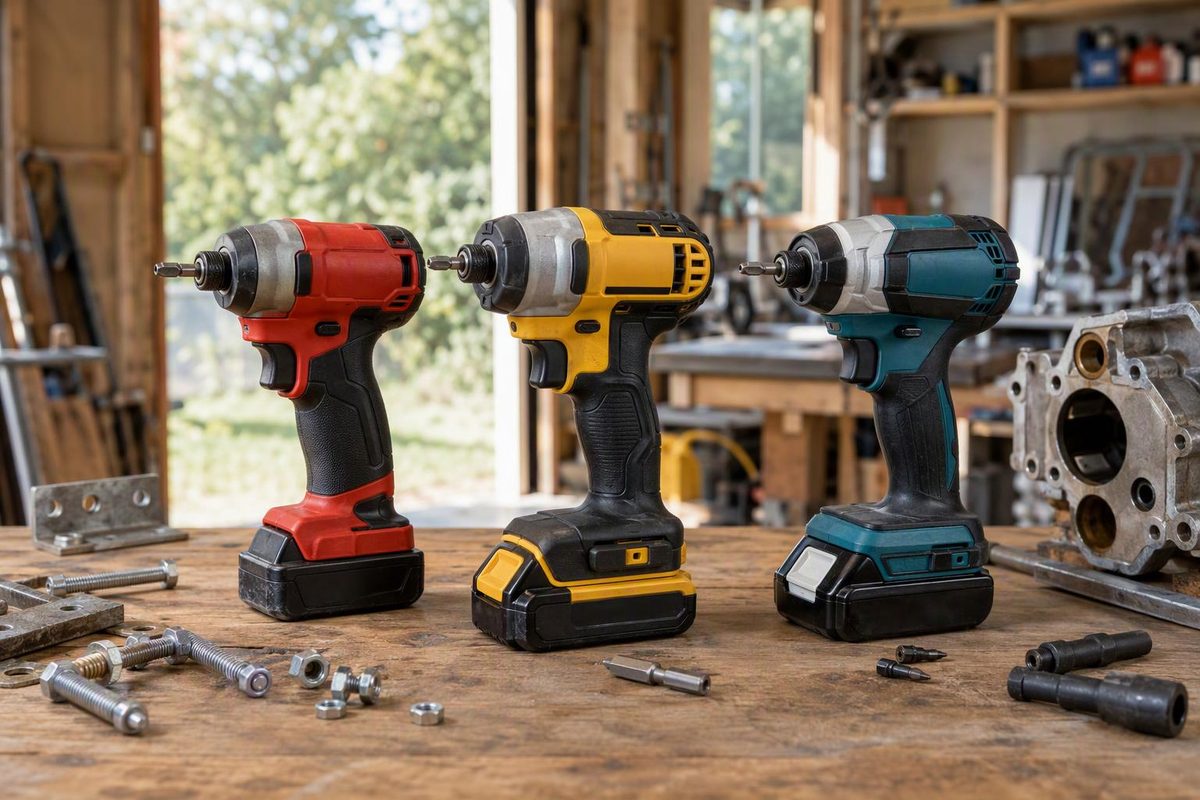
For a garage builder starting without cordless batteries and mainly doing bench assembly, the Milwaukee M12 FUEL 3453-20 is the default recommendation here. Its 5-inch body, selectable drive modes and lighting around the bit make it a sensible choice for fastening brackets, guards and workshop fixtures. If you already own DeWalt 20V MAX or Makita 18V LXT batteries, start with the matching alternatives below rather than buying another battery system.
These are feature-based buying recommendations, not results from a hands-on comparison. The priority is access and fastening control—not the highest advertised torque. Model details refer to US-market listings checked on October 31, 2026.
Milwaukee M12 FUEL 3453-20: default compact choice
Milwaukee lists a 5-inch length, up to 1,500 in-lb of torque, four-mode drive control including a dedicated self-tapping screw mode, and three LEDs surrounding the bit. It accepts M12 batteries and chargers. Those are the features behind this recommendation. Milwaukee specifications
Choose it when your impact driver will spend more time inside assemblies and around a bench than driving large screws all day. The selectable modes let you reduce the tool’s output for lighter work instead of relying entirely on a careful trigger finger.
Reason to choose something else: if you already have a suitable driver on another battery platform, the M12’s compact design may not justify another charger and spare battery. Also consider which cordless saw or grinder you intend to buy next before committing to a system.
If you need batteries and a charger, compare the complete cost of the 3453-22 kit against assembling a package around the tool-only model. Check the seller’s actual box contents.
DeWalt ATOMIC DCF850B: short head for DeWalt owners
The DCF850B is the shortlist choice when front-to-back clearance matters and you already use DeWalt 20V MAX batteries. DeWalt specifies a body under 4 inches long, 1,825 in-lb maximum torque, three-speed control and three LEDs. The B package excludes the battery and charger. DeWalt product details
There is independent evidence that the short body does not make it merely a light-duty screwdriver. In Pro Tool Reviews’ five-run test driving 8-inch GRK RSS screws into stacked OSB with 5.0Ah batteries, the DCF850 averaged 10.12 seconds against 9.64 seconds for the larger DCF887. That supports its usefulness for substantial screw driving, not a claim that it beats every current impact driver. Published comparison
Fit checkpoint: measure with the intended bit and battery attached. A short tool body alone does not tell you whether the complete setup clears a frame rail or reaches past a flange.
Makita LXT XDT20Z: choice for more fastening modes
For a builder already using Makita LXT, choose the XDT20Z when dedicated fastening modes are worth more than shaving another fraction off the body length. Makita lists four speed selections, a low-speed-start Assist Mode, two tightening modes for self-drilling screws in thin or thick metal, and reverse auto-stop to help avoid dropping loosened fasteners. Its stated length is 4½ inches, with 1,590 in-lb maximum torque and a light ring around the chuck. Makita specifications
Those modes make it the most appealing of these three for a shop that frequently switches between sheet-metal covers, wood fixtures and general assembly. They are aids to control, not calibrated torque settings.
Watch older buying guides: Makita now marks the XDT19Z discontinued and identifies the XDT20Z as its replacement. An old-stock discount may still be useful, but compare it against the current model rather than assuming they are identical. Makita replacement listing
Before you buy
- Compare complete packages: tool, compatible battery, charger and suitable bits—not just the bare-tool price.
- Try the grip and low-speed trigger with a battery fitted. For small machine screws, prefer a hand driver or a drill-driver with an adjustable clutch when damage would be costly.
- Keep the job distinction clear. These are ¼-inch hex impact drivers. If your main task is removing wheel nuts or seized automotive bolts, shop for a suitable square-drive impact wrench instead.
- Do not buy by torque alone. Maximum output is not the torque delivered to your particular joint. For example, Makita’s XDT19 instructions explain that fastening time, battery condition, fastener characteristics and operating technique affect torque; excessive impact force or fastening time can damage the screw or bit. XDT19 operating guidance
For specified mechanical joints, start threads by hand and stop powered rundown before the fastener seats. Complete seating and final tightening with hand tools, finishing to the manufacturer’s specification with the appropriate torque tool; see bolt torque basics. Budget for correctly fitting, impact-rated bits too—especially when choosing hex bits for socket-head screws.