
Self-Drilling Screws: Choose the Point and Check Drilling Limits
Choose self-drilling screws by material, drill-point capacity and usable length, then control speed and seating without stripping the joint.
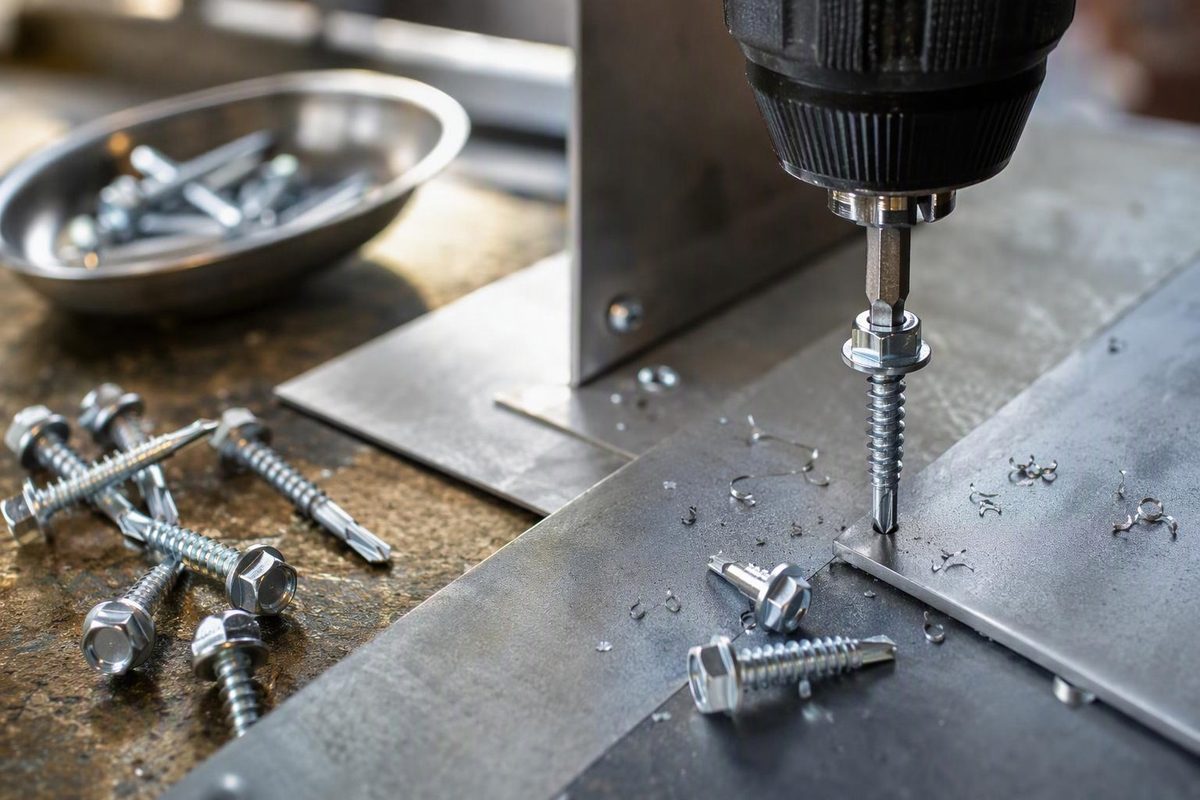
Choose a self-drilling screw by its published drilling range—not just its diameter or overall length. The drill point must suit the metal being pierced, and the screw must be long enough for the required threads to emerge behind the support.
A self-drilling screw drills its own hole, then forms the mating thread. It is a type of self-tapping screw, but its cutting point distinguishes it from a non-drilling tapping screw used in a prepared metal hole. Buildex describes the point as sizing the hole and the unthreaded pilot section as allowing drilling to finish before the threads begin tapping. For prepared-hole selection, use the separate self-tapping screw guide. (Buildex fastener features, pp. 4–5)
Measure the stack before choosing the point
For a sheet-metal cover attached to a steel bracket, record:
- Material: identify both the cover and support. Do not apply a steel drilling-capacity table to stainless steel or aluminum without product-specific confirmation.
- Thickness to be drilled: measure each metal layer the point must pierce and add those thicknesses for a tight, metal-to-metal stack.
- Attachment thickness: include any wood, spacer or insulation when checking usable screw length, even though it is not all steel to be drilled.
- Rear clearance: allow for the projecting drill point and threads; check for wiring, hoses and moving parts behind the joint.
A pre-punched top layer or a gap between members changes the arrangement. Check the manufacturer’s assembly diagram rather than treating every stack as two contacting sheets. Buildex distinguishes drilled top layers, pre-punched layers and voids in its point-selection diagrams. (Buildex selection diagrams, p. 5)
Point numbers are not universal thickness ratings
Look up the exact screw designation and product family, including the point type. The same point label can appear on screws with different drilling limits. For example, ICC-ES report ESR-3223, reissued November 2024, lists these ranges for Buildex Teks Select structural fasteners:
| Screw designation | Drill point | Total steel thickness it is designed to drill |
|---|---|---|
| #10-16 × 3/4 in., hex washer head | Tek/3 | 0.036–0.150 in. |
| #12-14 × 1 in., hex washer head | Tek/3 | 0.036–0.187 in. |
| 1/4-20 × 1-1/2 in., hex washer head | Tek/4 | 0.210–0.312 in. |
These are product-specific examples, not a general Tek-number chart. Notice both the minimum and maximum: the larger-capacity point is not automatically suitable for thinner sheet. (ESR-3223, Table 1)
For a tight stack of two steel sheets each measuring 0.060 in., the total is 0.120 in. That falls inside the listed #10 Tek/3 drilling range. It checks drilling thickness only—not joint strength. Buying a longer screw does not, by itself, increase drilling capacity.
Check usable length, head and application
Do not count the drill tip as thread engagement. ESR-3223 requires the Teks Select screws to project at least three threads beyond the supporting steel and gives a product-specific minimum protrusion length. That length also accounts for the hardened tip zone, keeping the specified load-bearing portion in the joint. For the listed #10-16 × 3/4 in. screw, the minimum protrusion is 0.408 in. (ESR-3223, Sections 3.1 and 4.1–4.2 and Table 1)
In the 0.120-in. example, an under-head-to-tip length of 0.750 in. leaves 0.630 in. behind the stack. That clears the listed protrusion minimum; verify the actual screw length, assembly thickness and rear clearance before installation.
Choose the head for the surface it must clamp and the finish for the materials and environment. For wood-to-steel work, use a screw specified for that application: winged designs ream clearance through the wood so the threads do not engage it during drilling. They also have minimum steel-thickness requirements for reliably breaking off the wings. (Buildex wood-to-metal guidance, p. 16)
Drive a trial joint before the finished part
- Clamp representative offcuts together. Match the actual materials, thicknesses and layer arrangement. Wear eye protection and keep hands clear of the point’s exit path.
- Fit the correct driver and hold it square. ESR-3223 requires perpendicular installation for Teks Select screws.
- Use controlled speed within the product’s limit. For that family, the limits are 1,800 rpm for 1/4-in. screws and 2,500 rpm for the other listed sizes. These are ceilings, not universal target speeds. (ESR-3223, Section 4.2)
- Control the final seating with the product’s specified tool. For example, Buildex specifies a depth-sensitive screwgun for its light-duty Teks range: adjust the stop on the trial joint and remove chip buildup from the socket. Overdriving can break the screw torsionally or strip the substrate. (Buildex installation guidance, p. 6)
- Inspect both sides. Confirm full head seating, closed mating surfaces and the specified rear protrusion before repeating the setting on the finished assembly.
If the point spins without progressing, stop and recheck material, thickness range, point condition and speed rather than adding speed blindly. If the screw turns after seating without tightening, treat the hole as suspect—not as a completed fastening.
A successful trial verifies installation, not load capacity. For load-bearing work, use the exact product’s connection data: drilling capacity alone does not establish allowable pull-out, pull-over or shear load. ESR-3223’s connection strengths apply to steel members in direct contact; cyclic or fatigue loading is outside its scope. Do not treat those tables as approval for a repeatedly loaded machine joint. (ESR-3223, Sections 4.1.2 and 5.4)