
Vintage Mabuchi Slot-Car Motors by Family
Physical features narrow the family. The complete code, drive arrangement and evidence tied to the motor, package, kit or chassis help confirm the identification.
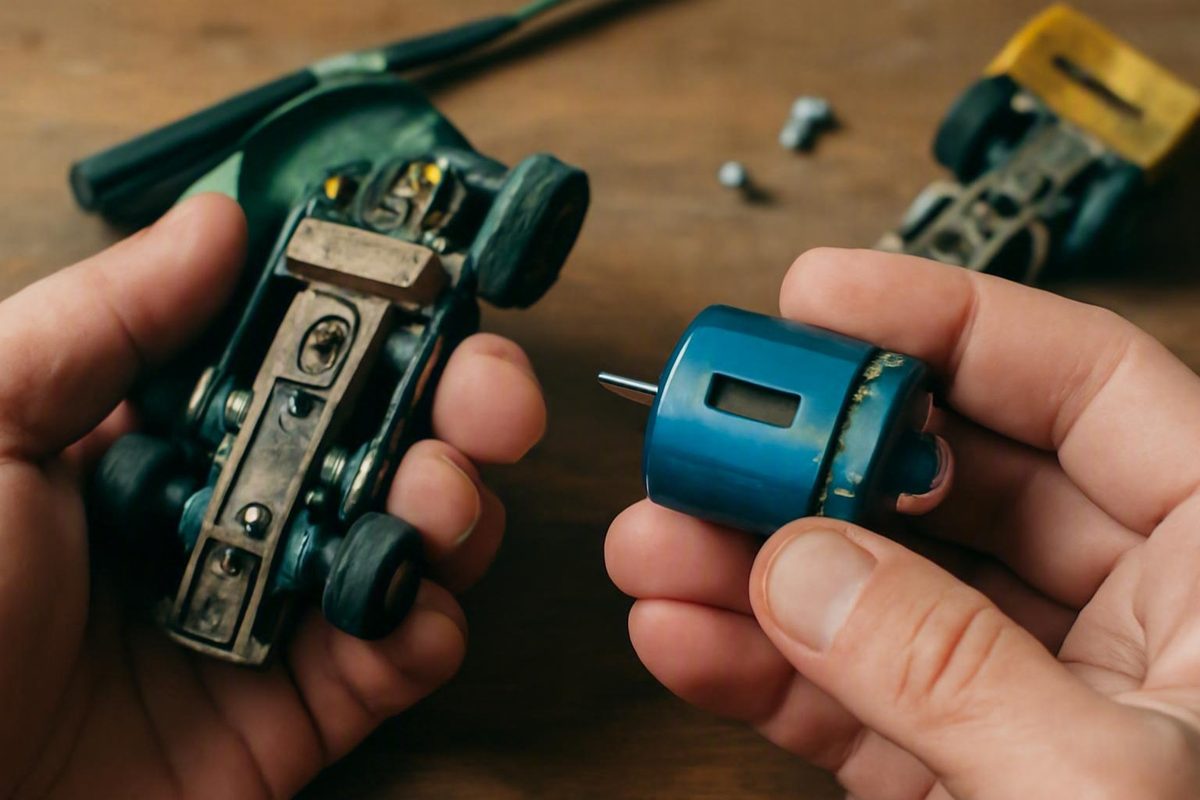
Identifying Mabuchi motors in vintage slot cars is rarely a one-clue exercise. Can color may vary with voltage, reseller, application, or later repainting. A familiar logo may identify the company that sold the car rather than the company that made its motor. Even a correct family label—such as 16D or 36D—does not establish the exact variant, drive side, voltage, armature fit, or originality.
A defensible identification combines the motor family, complete markings, construction, shaft arrangement, drive orientation, voltage clues, and application-specific provenance. This is therefore an evidence-graded overview and collector worksheet, not a definitive factory catalog. Where the clues disagree, a qualified identification is more useful than a forced model name.
What Counts as a Vintage Mabuchi Slot-Car Motor?
This guide covers the early Type 15, Type 15R, and incompletely documented Type 35R motors associated with home-set slot cars, followed by the FT-16/16D, FT-26/26D, and FT-36/36D families associated with 1960s racing and replacement markets.
The available evidence is uneven. It is strongest for individual loose motors, selected variants, reseller designations, and replacement parts. It does not provide a complete list of every slot-car model originally equipped with a Mabuchi motor, nor does it replace period packaging, instructions, catalogs, or engineering literature when those survive.
Several categories are easily confused:
- Mabuchi-made: Manufactured by Mabuchi, whether or not the can bears the Mabuchi name.
- Mabuchi-branded: Marked or packaged explicitly as Mabuchi.
- Rebadged OEM: Made by Mabuchi but sold under another company’s brand or catalog designation.
- Mabuchi-based: Built around a Mabuchi can, endbell, or basic format but assembled or modified with third-party parts.
- Mabuchi-style: Resembling a familiar Mabuchi format without evidence that Mabuchi manufactured it.
That distinction matters because Mabuchi supplied motors to other companies. A Revell-, Cox-, or Eldon-marked motor may be Mabuchi-built, but the logo alone does not prove it. Conversely, an item placed in a retailer’s “Mabuchi” category may contain parts made by Classic, Champion, Motors Etc, or another supplier.
The early Type and FT families should also be kept separate from later FC-130, FC-180, FK-130, and low-profile FF-series terminology. The informal term S-can has been used broadly and inconsistently. Forum contributors discussing these later formats emphasize that a letter prefix or colloquial can name is not a complete model identification; the full designation is preferable when it survives on the motor or packaging (discussion of FC, FK, FF, and S-can terminology).
Four evidence labels are used here:
- Archived specialist reference: A construction, voltage, drive, or brand detail recorded in the surviving identification guide.
- Retrospective specialist interpretation: A later historical account drawing on period knowledge, magazines, or collecting experience.
- Forum recollection: A participant’s identification, memory, measurement, or reconstruction.
- Retailer claim: A seller’s product description, compatibility statement, condition label, price, or stock status.
These categories are not interchangeable. A retailer page can establish that an item was offered under a stated description when the page was captured, but it does not independently verify the historical or dimensional accuracy of that description. A collector’s comparison may be informed and useful without carrying the authority of factory documentation.
Exact factory specifications for every variant, universal interchangeability, definitive production dates, and current valuations remain outside the supported scope.
From Type 15 Home-Set Motors to the FT Racing Families
The surviving specialist history traces Kenichi Mabuchi’s research institute to 1946, horseshoe-shaped magnetic-motor production to 1947, the formation of Tokyo Science Industrial Company for small-motor manufacturing to 1954, automatic armature winding to 1955, and ferrite-magnet adoption to 1958. It places Type 15, 15R, and probably 35R motors in early-1960s slot-car use and dates a carbon-brush FT motor for model racing cars to April 1963 (archived Mabuchi motor history and identification guide).
Those early Type motors belong primarily to the home-set period, when manufacturers needed compact, economical power units for packaged cars and relatively simple chassis. The archived account provides useful detail for Type 15 and several 15R configurations. Its accessible text ends partway through the 35R section, however, so the 35R’s probable period should not be expanded into an inferred voltage, color, shaft layout, or exact release date.
The reported April 1963 FT introduction marks a product development, not an immediate market-wide transition. Older motor types did not disappear at once, and different manufacturers adopted new formats at different times.
Retrospective histories place particular emphasis on the middle of the decade, when Mabuchi formats became important in 1/24- and 1/32-scale racing. One such account describes Revell and Russkit as improving and importing Mabuchi motors, the smaller 16D as the enduring development path, the larger 36D as briefly prominent on commercial tracks, and the intermediate 26D as a less enduring branch (retrospective slot-racing history).
These are historical interpretations, not controlled factory comparisons. They describe adoption and influence rather than proving that one family was universally faster, more efficient, or better made. Chassis fashion, class rules, available parts, packaging, cost, and builder preference all affected which formats persisted.
| Period | Development | Evidence status |
|---|---|---|
| Late 1940s–1950s | Corporate and manufacturing developments preceding Mabuchi’s slot-car motors | Reported by the archived specialist history; not itself a slot-car production chronology |
| Early 1960s | Type 15 and 15R associated with home-set slot cars | Reported in the archived identification reference |
| Early 1960s | Type 35R placed in the same broad period | Probable; the accessible account is incomplete |
| April 1963 | Carbon-brush FT motor reported as introduced for model racing cars | Specific date reported by the archived specialist reference |
| Mid-1960s | FT-format motors become especially important in organized 1/24 and 1/32 racing | Retrospective specialist interpretation |
| Later 1960s | 16D persists while 36D prominence recedes and 26D proves less enduring | Retrospective interpretation, not a factory-defined sequence |
The chronology should therefore be read as an evidence map rather than a complete production calendar.
The Main Families: 15, 15R, 35R, 16D, 26D, and 36D
The following comparison is an identification aid, not a universal specification sheet. “Reported voltage” means that the supplied evidence documents examples in that configuration; it does not mean every motor carrying the family name had the same winding, rating, or application.
| Family | Broad era | Reported voltage | Known or reported drive arrangements | Identifying clues | Reported applications | Evidence confidence |
|---|---|---|---|---|---|---|
| Type 15 | Early 1960s | 12 V | Endbell-drive in the archived description | Short shaft; dark-blue can reported | Home-set use, including Eldon-associated examples | Archived specialist reference |
| Type 15R | Early 1960s | 6 V and 12 V variants | Can-drive and endbell-drive examples | Multiple iterations; finish, vents, shaft length, and drive side vary | Strombecker, Revell, Aristo-Craft, BuzCo, Mini-Auto Products, and chassis-kit associations | Archived reference, supplemented by collector discussion |
| Type 35R | Probably early 1960s | Not established here | Not established here | Family name survives, but the accessible description is incomplete | Early slot-car period | Low confidence |
| FT-16/16D | 1960s racing era | 12 V in the archived FT-16 examples | Endbell-drive in the archived variant descriptions | Compact FT format; variant-specific finish and construction | Racing and replacement use; retrospective Revell and Russkit associations | Archived reference and retrospective history |
| FT-26/26D | Mid-to-late 1960s | Not safely generalized here | Endbell-drive, can-drive, and dual-shaft forms reported by collectors | Intermediate format; exact variant requires physical comparison | Racing and performance-building applications | Primarily retrospective and forum evidence |
| FT-36/36D | Mid-1960s onward | 12 V configurations reported | Can-drive and endbell-drive configurations documented | Larger can; multiple branded versions and numerous listed service parts | Revell, Cox, Monogram, K&B, Champion, and other racing-market associations | Archived reference, retrospective history, and retailer records |
The Type 15, 15R, 35R, FT-16, and documented FT-36 details above come from the archived specialist reference cited in the chronology; that source is incomplete and is not a Mabuchi factory record. The 26D arrangements are collector reports rather than factory specifications.
Type 15
The archived reference describes Type 15 as a 12-volt, short-shaft, endbell-drive motor with a dark-blue can. That cluster of characteristics is more useful than any one of them alone. Dark blue by itself is not an identification.
An Eldon collector discussion demonstrates the problem. Participants initially relied partly on memories of a short blue motor and considered a 15R identity. Spotter-guide author Steve Okeefe ultimately identified the pictured Eldon examples as Type 15 rather than 15R (Mabuchi 15R spotter-guide discussion).
The discussion is not factory documentation, but it shows why color and brand memory should be checked against drive side, shaft form, vents, and end construction.
Type 15R
Type 15R was not one visually uniform motor. The archived account reports both 6-volt and 12-volt configurations, different drive orientations, multiple finishes, and varying shaft lengths. It associates red with certain 6-volt examples, but that does not make either “red equals 15R” or “red equals 6 volts” a universal rule.
Two motors can therefore both be described as 15R while differing in output end, voltage, finish, vents, or intended application. A family identification is only the beginning of the description.
The meaning of the R suffix is unresolved in the supplied evidence and should not be expanded into a supposed factory term.
Type 35R
Type 35R appears in the early sequence, but the accessible record is sparse. The archived source gives probable dating before its surviving text cuts off. That supports the cautious description “probably an early-1960s family,” not a reconstructed voltage, shaft arrangement, color, or release month.
If a seller calls a loose motor a 35R, ask what supports the attribution. Period packaging, instructions, a complete marking, or a close comparison with a documented example carries more weight than approximate resemblance to a 15R.
FT-16 and 16D
The FT-16 variants in the archived reference are described as 12-volt, short-shaft, endbell-drive motors, with finish and construction differences among the listed versions. Retrospective accounts give the broader 16D format its historical significance and describe its continued development in racing.
“16D” remains a family or format description rather than a complete identity. Original Mabuchi units, rebadged motors, later replacement assemblies, and motors rebuilt with aftermarket magnets, endbells, brushes, or armatures can all appear under that broad label.
Do not infer a can-drive FT-16 variant merely because later historical accounts discuss can-end-drive motors in 16D sizes. A particular motor’s construction and period description still need to be established.
FT-26 and 26D
The 26D sits between the better-known 16D and 36D families and has a less orderly surviving record. Collectors report endbell-drive, can-drive, and dual-shaft examples.
In a restoration discussion, participants correspond Classic CM450 with endbell-side drive, CM460 with can-side drive, and CM470 with twin shafts. Those correspondences are forum assertions, not Mabuchi factory documentation, so they are best treated as leads for comparison rather than proof from the model name alone (John Havlicek’s 26D restoration and identification discussion).
Claims that the 26D was inherently faster because of tighter air gaps, stronger magnets, or a particular armature stack are not supported here by standardized comparative testing. Rebuilt examples may perform strongly, but magnet changes, windings, armatures, alignment, gearing, and chassis condition prevent a reliable family-level ranking.
FT-36 and 36D
The archived reference reports FT-36 examples in both can-drive and endbell-drive 12-volt configurations. Branded motors and service components also appear across captured specialist retailer catalogs under Cox, Monogram, Revell, K&B, Champion, and third-party parts descriptions.
That catalog presence can make the 36D seem easier to identify than it is. A replacement armature or endbell can change compatibility, while a branded can may outlast all its original internal components. Identify the physical assembly in front of you, not the reputation of the logo.
A retailer category documents multiple 36D-branded motors and parts, but it does not establish the factory configuration or manufacturer of every item placed in that category (captured catalog of 36D motors and service parts).
No family should be ranked here by speed. RPM titles, magnet readings, racing recollections, and “high-performance” labels lack consistent voltage, load, temperature, gearing, instrumentation, and condition controls.
A Feature-by-Feature Identification Method
Treat the motor as an artifact before treating it as a component to be powered, cleaned, or rebuilt. Record what exists before changing it.
Use this identification worksheet:
- Complete markings: Transcribe every stamped, printed, etched, or handwritten character. Preserve spaces, hyphens, suffixes, and line breaks.
- Can measurements: Record length, width, and height without assigning a family from size alone.
- Voltage markings: Photograph and transcribe any explicit rating.
- Both ends: Take square, well-lit photographs of the endbell and metal-can ends.
- Can finish: Note color, plating, paint texture, corrosion, fading, and evidence of repainting.
- Endbell: Record color, material, shape, openings, brush arrangement, terminal style, and visible heat damage.
- Vent pattern: Count and locate slots or holes.
- Shaft arrangement: Record whether the motor has one or two projecting shaft ends and measure each visible projection.
- Drive position: Note which shaft carries, or appears to have carried, the pinion.
- Bearings or bushings: Record their type and location without assuming originality.
- Leads: Note wire color, length, terminal style, soldering, and apparent replacements.
- Mounting features: Photograph holes, brackets, clips, solder marks, and chassis interfaces.
- Provenance: Retain packaging, instructions, the original chassis, listing photographs, and prior-owner notes.
Endbell-drive means the output shaft and pinion are on the endbell side. Can-drive means the output is on the metal-can side. Dual-shaft means the shaft projects from both ends, although a chassis may use only one projection.
Drive orientation matters because it places the pinion relative to the chassis and gear. It may also affect armature and replacement-part fit. Two motors sharing a family label but having opposite output arrangements are not automatically interchangeable.
Color should be used late in the process. It can corroborate a conclusion already supported by construction, code, voltage, and provenance, but it should not override them. Repainting, oxidation, reseller finishes, and substituted cans all weaken color evidence.
Use this decision sequence:
- Establish the broad construction family. Compare proportions, can form, endbell shape, vents, and mounting method.
- Determine shaft and drive arrangement. Record endbell-drive, can-drive, or dual-shaft construction and the apparent pinion position.
- Read the complete code and voltage. Prefer the full designation over a partial prefix or informal can name.
- Compare branding and applications. Look for evidence tied to a specific motor, package, chassis, kit, or reseller designation.
- Check for mixed parts. Fresh solder, modern leads, altered brush hardware, adhesive, tool marks, or mismatched wear may indicate rebuilding.
- Assign a confidence level. Separate direct observation from documented comparison and inference.
Useful conclusions include:
- “Type 15 matching the archived endbell-drive description.”
- “Probably a 15R, but voltage and reseller variant remain unidentified.”
- “26D-format motor with reported Classic branding; exact model unconfirmed.”
- “36D-based rebuilt motor containing later service parts.”
- “Unidentified vintage closed-can motor; insufficient evidence for Mabuchi attribution.”
The last answer is sometimes the most accurate. An exact model name should not be forced onto conflicting or incomplete evidence.
Photograph and measure before disassembly. Removing a pinion, replacing wires, cleaning a stamp, opening tabs, or changing an endbell may erase clues that later prove more valuable than the repair itself.
Why the Motor May Carry Another Company’s Name
Mabuchi’s OEM role is central to vintage identification. Motors supplied to other companies could appear under those companies’ brands, part numbers, or product names. A genuine Mabuchi-built unit therefore may never have been labeled simply “Mabuchi.”
The archived reference associates individual early motors or applications with Eldon, Strombecker, AMT, Revell, and Aristo-Craft. It also connects certain 15R motors or compatible chassis kits with BuzCo, Mini-Auto Products, Auto-Hobbies, and Kemtron. These are application-level associations, not evidence that every product from those companies used a Mabuchi motor.
| Reported reseller designation | Reported relationship | Evidence status |
|---|---|---|
| Aristo-Craft R-2 | Dark-gray, endbell-drive 15R | Archived specialist reference |
| Aristo-Craft 15R-6 | Six-volt, endbell-drive 15R | Archived specialist reference |
| BuzCo X-10 | Six-volt, can-drive 15R | Archived specialist reference |
| Mini-Auto Products Red Bomb | Six-volt, can-drive 15R | Archived specialist reference |
A loose red motor does not become a Red Bomb merely because it resembles the description. Packaging, markings, branding, or application provenance should support the attribution.
FT-era associations include Revell, Russkit, Cox, Monogram, K&B, Classic, and Champion, but the relationship differs by item. One company may have installed a Mabuchi-built motor in a car; another may have sold a modified version; another may have produced replacement parts for a Mabuchi format.
Tyco HP7 replacements belong to a separate HO-scale context rather than the 1960s 1/24- and 1/32-scale racing narrative. One retailer describes a five-pack as Tyco item 6577, unused warehouse stock, and compatible with HP7 applications. Image alt text or metadata on the same page refers to 6576, while the page is marked backordered and also displays pickup-related information (Tyco 6577 Mabuchi motor-pack listing).
Use this provenance hierarchy:
- Period packaging, instructions, or an intact documented chassis
- Complete motor markings and catalog codes
- A close construction match to a documented example
- Color, memory, or an unsupported seller description
Even strong branding does not guarantee an untouched motor. A branded can may now contain a replacement armature, endbell, brushes, springs, magnets, bearings, or leads. When the evidence supports it, describe the example as rebuilt or mixed-part rather than treating the can as proof of the entire assembly’s originality.
Matching Drive Layouts and Replacement Parts
Begin every fit check with drive orientation rather than the family name alone. An FT-36D armature intended for can-side drive is not automatically interchangeable with an endbell-side-drive application. The broad family may describe the envelope while leaving shaft projection, stack position, commutator placement, and output geometry unresolved.
| Product | Retail description | Seller-claimed fit |
|---|---|---|
| MAB010 | Classic FT-36D can-drive armature | Mabuchi, K&B Hellcat, and Cox NASCAR motors |
| MAB012 | Endbell-side-drive FT-36/FT-36D armature | Listed FT-36 and FT-36D examples, including K&B- and Cox-branded motors |
| MAB2677 | Mabuchi brushes | FT-16D and FT-26 |
| Champion MOT-006 | Shunted brushes | Mabuchi FT-16, FT-16D, and FT-26 |
All four compatibility entries are seller claims from the captured Electric Dreams catalog, not independent dimensional verification (vintage motors and replacement-parts catalog).
The same catalog demonstrates why a Mabuchi-category product code does not necessarily identify the maker: MAB010 is described as made by Classic, while Champion-branded brushes are offered for Mabuchi formats.
Captured retailer catalogs also list 36D service categories such as:
- Complete endbells and endbell blanks
- Brush holders or heat sinks
- Brush springs
- Bearings or bushings
- Armature washers
- Armature blanks
- Motor clips
- Self-tapping screws
- Complete motors and armatures
Catalog presence does not establish that a component fits every FT-36 or 36D. The supplied sources do not provide a verified matrix of shaft diameters, armature-stack dimensions, commutator positions, bearing geometry, mounting dimensions, or electrical characteristics.
Before buying a motor or component, compare:
- Drive side
- Number of shaft projections
- Exposed shaft length at each end
- Pinion position and gear alignment
- Endbell shape and attachment
- Brush dimensions and holder arrangement
- Spring style
- Bearing or bushing type and location
- Armature stack and commutator position, where visible
- Mounting holes, clips, brackets, and solder surfaces
- Complete readable code
- Evidence of previous modification
Ask the seller for direct photographs with a ruler or caliper in frame when critical measurements are absent. “Fits 36D” is less useful than clear views of both ends and measured shaft projections.
Separate servicing from modification. Replacing damaged leads, brushes, springs, or a demonstrably compatible wear component may be reversible routine work. Rewinding the armature, fitting different magnets, drilling the can, changing shaft geometry, or structurally reinforcing the endbell alters the motor’s condition and may affect historical originality.
A track-use rebuild and a preservation-focused restoration can both be legitimate. The important point is to choose deliberately and document what changed.
Inspecting an Old or NOS Motor Without Assuming It Is Ready to Run
NOS, or new old stock, means old inventory represented as unused. It does not establish present operation, absence of corrosion, original internal condition, voltage, or chassis compatibility.
Keep the first inspection non-powered and observational:
- Look for rust, oxidation, staining, or residue.
- Examine leads for cuts, brittle insulation, old repairs, and broken strands.
- Check the endbell for cracks, warping, discoloration, or heat-affected areas.
- Confirm that visible holders, springs, terminals, and bushings appear seated.
- Inspect accessible brushes for damage or contamination.
- Look through vents for debris, displaced material, or corrosion.
- Note bent tabs, fresh solder, adhesive, mismatched hardware, and tool marks.
- Record whether the shaft turns freely under light handling, without forcing it.
- Compare the motor with listing photographs to identify changes in transit or handling.
This checklist documents condition; it does not establish electrical safety or readiness to operate.
Do not infer voltage from can color or a broad family reputation. The surviving specialist account reports both 6-volt and 12-volt Type 15R configurations, so an unidentified example should not be treated as a known 12-volt motor merely because it resembles another 15R.
No universal power-up procedure is supported by the supplied evidence. When voltage, winding, insulation condition, or internal state is unknown, stop at documentation and seek model-specific information or an experienced technical assessment before attempting operation.
John Havlicek’s documented 26D project illustrates how extensive an enthusiast rebuild can become: the work included bearing replacement, endbell reinforcement, brush-tube alterations, magnet changes, and a replacement armature. It is evidence of the interventions one builder encountered, not a Mabuchi service procedure or a recommendation for every 26D.
Make an originality decision before invasive work:
- Preservation: Document the motor and avoid opening or altering it unless needed to arrest deterioration.
- Reversible servicing: Address replaceable wear components while preserving removed parts and avoiding structural changes.
- Period-style rebuilding: Use historically appropriate components or techniques and record substitutions.
- Performance modification: Alter the armature, magnets, timing, shafting, or structure and identify the result as modified.
Keep removed components in a labeled bag. Record the date, observed condition, measurements, replacement part, source, and reason for the work. Photograph each stage so later owners can distinguish apparent factory construction, period modification, and modern restoration.
Buying and Troubleshooting Mabuchi-Powered Vintage Slot Cars
A motor claim should increase the amount of checking you do, not the amount you are willing to assume. Watch for these listing red flags:
- An incomplete code such as “Mabuchi 36D” with no variant information
- No photograph of one end, particularly the output end
- No dimensions for a loose motor
- An unclear or incorrectly described drive side
- “High performance” or “race tuned” without test conditions
- An RPM figure without voltage, load, temperature, equipment, or method
- “Tested” without an explanation of what was tested
- Conflicting product numbers or metadata
- Uncertain provenance represented as fact
- Ambiguous or changing availability language
- No-return terms paired with unclear condition
- An originality claim despite visible new solder, leads, hardware, or endbell parts
The Tyco listing discussed earlier is a useful example. Its title and description identify item 6577, while image metadata refers to 6576. That discrepancy does not prove the motors are misidentified, but it should be resolved before the page is treated as documentation.
Retail prices and inventory counts are dated snapshots. They cannot establish current value, rarity, or continuing availability. Likewise, the 32,000 RPM wording attached to a Cox 36D retailer title is an unverified seller claim because no test voltage, load, temperature, or measurement method accompanies it.
For a complete car that runs slowly, inspect the system before blaming the motor:
- Pickups and track contact: Check cleanliness, alignment, wear, and consistency.
- Electrical connections: Inspect wiring, terminals, solder joints, switches, and connectors.
- Gearing: Look for poor mesh, damaged teeth, binding, loose gears, or misalignment.
- Axles and bearings: Check for restricted movement, bending, or pinching.
- Tires and wheels: Look for hardening, eccentricity, rubbing, or body contact.
- Chassis drag: Check for components touching the track, body, gears, wheels, or shafts.
- Motor mounting: Confirm that the motor is secure and the pinion remains aligned.
- Motor condition: Only after external causes are considered should brushes, commutator condition, bearings, magnets, and armature become the main suspects.
Forum racers discussing nominally similar cars identify gearing, tires, chassis preparation, weight, corner speed, and driving as possible reasons for different lap times. Their anecdotes do not establish universal percentages or motor specifications, but they reinforce that lap performance belongs to the whole car rather than the motor label alone (discussion of motor tuning and whole-car performance).
Keep a buyer record containing:
- Seller’s exact wording
- Original listing URL and access date
- Photographs of both motor ends
- Packaging and chassis photographs
- Claimed manufacturer and model
- Complete visible code
- Claimed voltage
- Drive orientation and shaft count
- Dimensions supplied or measured
- Test status and stated conditions
- Known alterations or replaced parts
- Return terms
- Asking price and date
- Confidence level: documented, probable, possible, or unidentified
Frequently Asked Questions
What is the difference between can-drive and endbell-drive Mabuchi motors?
A can-drive motor has its output shaft and pinion at the metal-can end. An endbell-drive motor has the output at the endbell side. A dual-shaft motor projects a shaft from both ends.
The distinction affects pinion position, chassis layout, gear alignment, and possible armature fit. Two motors or armatures are not automatically interchangeable merely because both carry the same broad family label.
Can color identify a Mabuchi 15 or 15R motor?
Not by itself. The surviving reference associates particular finishes with selected Type 15 and 15R configurations, but finish varied among voltages, resellers, applications, and variants. Motors may also have faded, corroded, or been repainted.
Use color only after comparing drive side, shaft length, endbell construction, vents, complete markings, voltage, and provenance.
Does NOS mean a vintage Mabuchi motor is tested and ready to run?
No. NOS means old inventory represented as unused. It does not establish current operation, absence of corrosion, originality, voltage, or compatibility.
Document the motor without power first. Treat any seller statement about testing or fit according to exactly what the seller says was checked.
Which replacement parts have been listed for FT-16D, FT-26, and FT-36D motors?
Retail catalogs have listed brushes for FT-16/16D and FT-26 formats; can-drive and endbell-drive armatures for selected FT-36/36D applications; and 36D endbells, holders, springs, bearings, washers, armature blanks, clips, and screws.
Some listed parts are made by Classic, Champion, Motors Etc, or other suppliers rather than Mabuchi. Compatibility remains seller-claimed unless period documentation or direct dimensional comparison supports it.
Why might a Mabuchi-powered slot car be slow even if the motor works?
Dirty or misaligned pickups, weak electrical connections, binding gears, hard tires, restricted axles, chassis drag, wheel or body interference, and unsuitable gearing can all reduce performance.
Inspect the complete car before concluding that the motor is weak. Chassis preparation and driving also affect lap performance, so a motor label alone cannot predict how fast a car will run.
The disciplined identification rule is straightforward: determine the family from several physical features, confirm the complete code and drive arrangement where possible, and trace branding through evidence tied to the particular motor, package, kit, or chassis. Preserve uncertainty when the record is incomplete. Color, reseller branding, an NOS label, or a performance claim is never sufficient by itself; documentation, measurements, provenance, and a clearly stated confidence level make a vintage Mabuchi identification useful.