
Bolt Grades: Identify SAE Grades and Metric Classes
Identify SAE Grade 2, 5 and 8 bolts and common metric classes, compare their strength, and check the specification before replacing hardware.
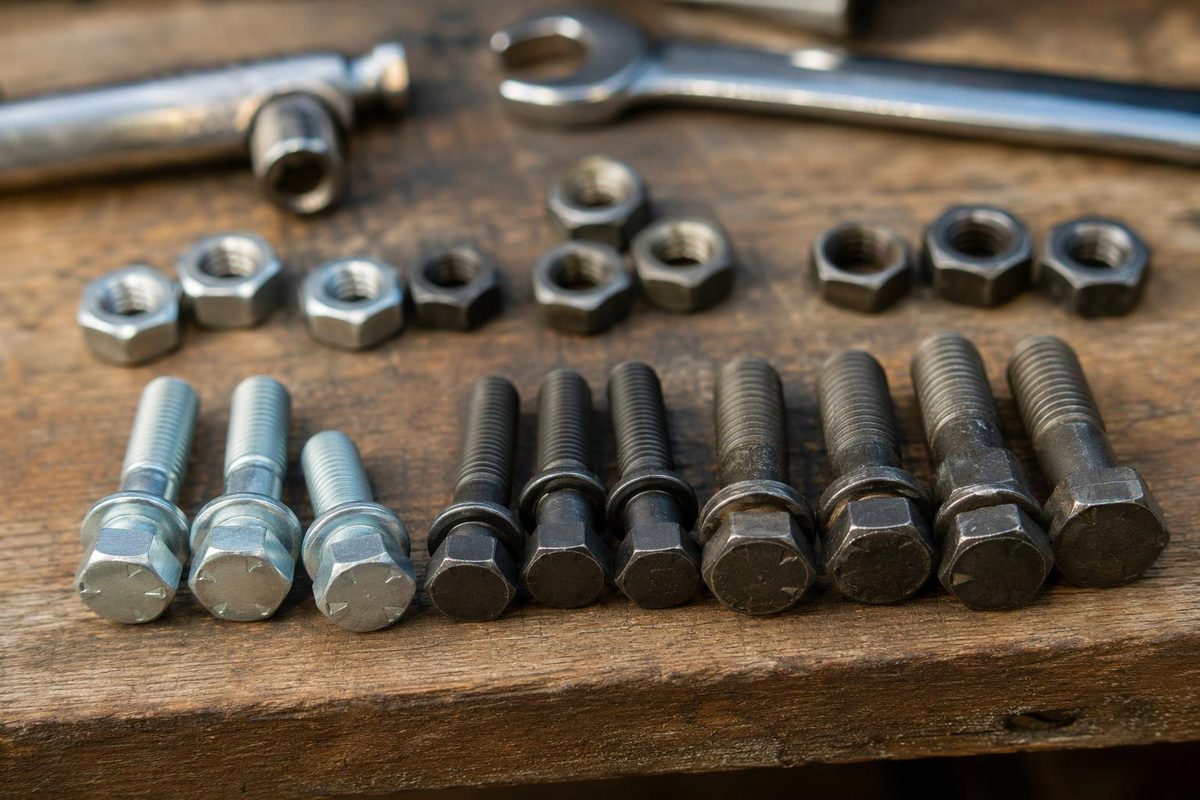
Three radial lines identify a common SAE Grade 5 bolt; six identify Grade 8. Metric steel bolts commonly carry a property-class number such as 8.8 or 10.9. These are different grading systems: metric class 8.8 is not SAE Grade 8. Bolt Depot’s marking chart shows both systems.
Use the marking to identify the strength specification, then separately check diameter, thread pitch, length and head style. A stronger bolt is not automatically a suitable replacement.
SAE bolt grades: count the radial lines
For common inch-series steel hex bolts, distinguish the grade lines from any manufacturer’s letters or logo. Grade 5 has three evenly spaced lines radiating toward the head’s edges; Grade 8 has six. Grade 2 has no grade marking, although a manufacturer’s mark may be present. Finish colour is not a reliable identifier: different grades can have similar zinc coatings. Bolt Depot’s materials guide describes these markings and finishes.
The following comparison applies to 1/4- through 3/4-inch nominal diameters. The Grade 2 figures apply to bolts no longer than 6 inches.
| SAE grade | Grade marking | Proof stress, psi | Minimum yield strength, psi | Minimum tensile strength, psi |
|---|---|---|---|---|
| 2 | No grade lines | 55,000 | 57,000 | 74,000 |
| 5 | Three radial lines | 85,000 | 92,000 | 120,000 |
| 8 | Six radial lines | 120,000 | 130,000 | 150,000 |
These values come from Portland Bolt’s SAE J429 summary. Size matters: Grade 2 requirements drop above 3/4 inch, and Grade 5 requirements drop above 1 inch. Grade 2 bolts longer than 6 inches use the lower Grade 1 requirements.
An unmarked loose bolt is not verified Grade 2. SAE Grade 1 also has no grade marking. If the bolt’s origin is unknown, a blank head cannot establish its specification. Keep unknown hardware out of joints whose safety depends on a known grade.
Metric bolt classes: read the number
Metric carbon- and alloy-steel bolts use property classes under ISO 898-1. For 8.8, the nominal tensile strength is 800 MPa and the nominal yield-to-tensile ratio is 0.8—giving 640 MPa nominal yield strength.
Nominal values are not a substitute for the specification table. For example, class 10.9 has a nominal tensile value of 1,000 MPa, but its specified minimum is 1,040 MPa. Ganpati Precision Fasteners’ ISO 898-1 extract distinguishes nominal values from required minima.
For ordinary, non-structural, full-loadability steel hex bolts in the common M6–M12 range:
| Metric class | Head class marking | Proof stress, MPa | Minimum yield strength, MPa | Minimum tensile strength, MPa |
|---|---|---|---|---|
| 4.6 | 4.6 | 225 | 240 | 400 |
| 8.8 | 8.8 | 580 | 640 | 800 |
| 10.9 | 10.9 | 830 | 940 | 1,040 |
| 12.9 | 12.9 | 970 | 1,100 | 1,220 |
Source: ISO 898-1 mechanical-property tables. The yield column uses lower yield strength for class 4.6 and 0.2% offset yield strength for the other listed classes. Do not extend this table to every screw geometry: low or countersunk heads can have reduced loadability.
At these sizes, class 8.8 and SAE Grade 5 have broadly similar tensile-strength levels; class 10.9 and SAE Grade 8 do too. That is a strength comparison, not permission to interchange them. Their threads and governing specifications still differ.
What the strength figures actually tell you
- Proof stress relates to the tensile load the fastener must withstand without permanent set.
- Yield strength describes the onset of a specified permanent deformation.
- Tensile strength describes the maximum tensile stress reached before fracture.
These definitions are summarised in Bolt Depot’s strength chart. Psi and MPa are stress units, not pounds or newtons of load. A strength number alone is neither a joint load rating nor a tightening torque.
Stainless markings use another system
Do not read A2-70 as an SAE grade or a metric 8.8-style code. A2 is a stainless material designation; 70 identifies a minimum tensile strength of 700 MPa. SK Bolts’ stainless fastener data separates the steel grade from the strength class.
Likewise, 18-8 and 316 describe stainless materials, not guaranteed replacements for hardened steel grades. Corrosion resistance and strength are separate selection questions. Common stainless fasteners can be substantially weaker than hardened steel fasteners. Bolt Depot’s materials guide explains the distinction.
Before ordering or assembling
- Clean and photograph the head. Record every line, number and manufacturer’s mark without grinding the markings away.
- Measure the fit separately. Confirm diameter, pitch, under-head length, threaded length and head geometry. A grade marking does not tell you these dimensions.
- Match the required specification. For a repair, use the equipment’s fastener callout rather than automatically choosing a higher grade. Some bolts intentionally fail before more costly components; stronger replacements are not always safe.
- Specify the mating hardware and tightening conditions. Confirm the nut, washer and finish requirements with the drawing, equipment maker or supplier. Grade alone does not specify torque/clamp-force performance, as the ISO 898-1 scope makes clear. For assembly guidance, see bolt torque basics.
For a scratch-built load-bearing joint, identifying the bolt grade is the starting checkpoint—not verification that the finished joint can carry its intended load.