
Drill, Tap and Die Chart: Metric Holes vs Rod Blanks
Compare common metric cutting-tap drills with manufacturer-listed die blanks, then check tool markings, rod preparation and finished thread fit.
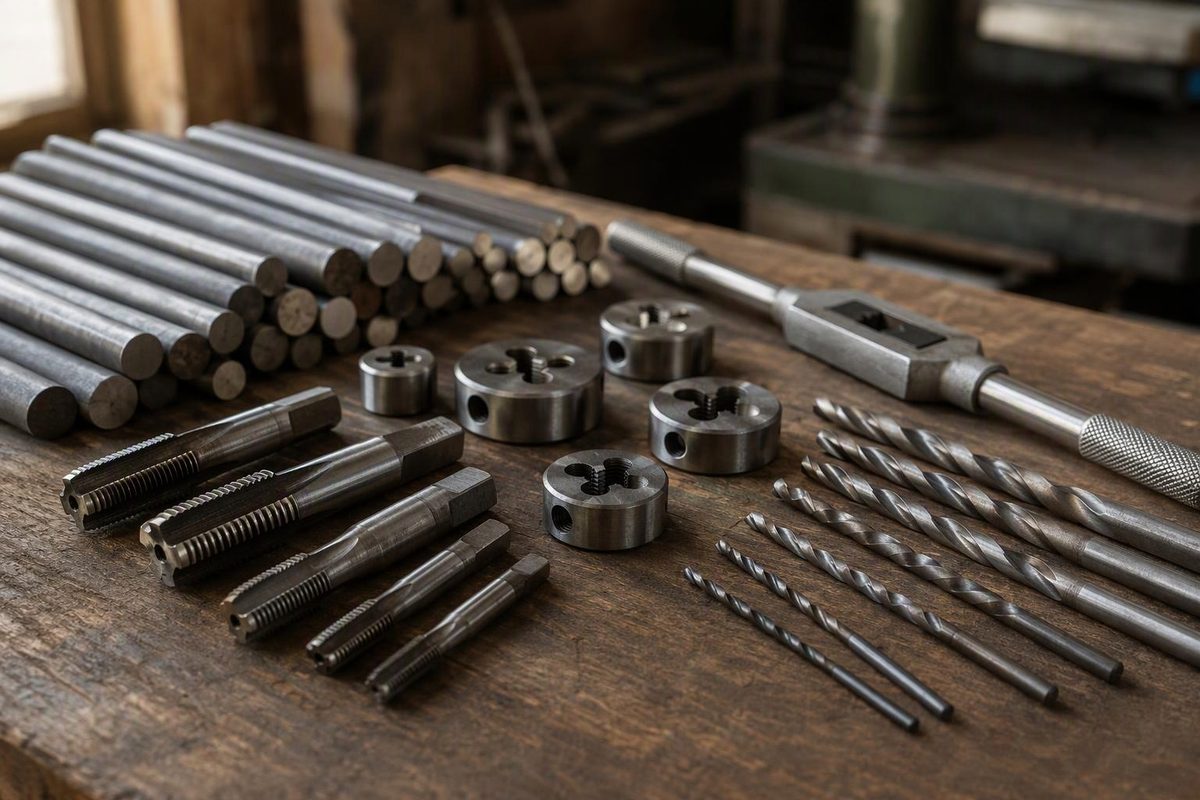
A tap needs a drilled hole; a cutting die needs a prepared rod. They do not use the same starting diameter. For example, an M6 × 1 cutting tap commonly uses a 5.0 mm drill, while Gühring lists a 5.88 mm workpiece diameter for its series 121 M6 × 1 die. Both tools produce the same nominal thread designation, but on opposite sides of the joint. (Allied Machine metric chart, Gühring die data)
The comparison below covers common metric straight threads. For the broader inch and metric hole lookup, use the drill and tap guide chart. Neither chart supplies clearance-hole, NPT or screw-thread-insert preparation dimensions.
Metric chart: cutting-tap hole versus die blank
In M8 × 1.25, M8 identifies the nominal thread diameter and 1.25 is the pitch in millimetres. Read the complete marking: a different pitch requires a different tool and tap drill. Match thread hand too.
Tap-drill choices below agree between Allied Machine and Newman Tools. They are conventional cutting-tap starting selections, not finished-thread tolerances; the tap maker’s application guidance and drawing requirements take priority.
The last column reproduces Gühring’s listed workpiece outside diameters for series 121 right-hand, tolerance-class 6g dies. These are recommendations for that tool series, not universal blank sizes for every die with the same marking. (Gühring series 121)
| Thread—tap or matching die | Cutting-tap drill, mm | Gühring 121 die workpiece OD, mm |
|---|---|---|
| M3 × 0.5 | 2.5 | 2.92 |
| M4 × 0.7 | 3.3 | 3.91 |
| M5 × 0.8 | 4.2 | 4.90 |
| M6 × 1 | 5.0 | 5.88 |
| M8 × 1.25 | 6.8 | 7.87 |
| M10 × 1.5 | 8.5 | 9.85 |
| M12 × 1.75 | 10.2 | 11.83 |
Forming taps require larger starting holes than cutting taps. An undersized forming-tap hole can cause excessive torque and tap breakage; obtain the selected tool’s hole specification rather than using this table. (Superior Machine Tools)
Select the die and prepare the rod
The thread designation is the die size—not the tap-drill diameter. An M6 × 1 tap pairs with an M6 × 1 die, not a die marked 5 mm. The same distinction applies to inch tools: a 1/4-20 tap pairs with a 1/4-20 die, not a die marked with its #7 tap-drill size.
Do not turn every die blank to the nominal thread diameter, or subtract one fixed amount from every size. Check your die maker’s workpiece recommendation and the drawing’s finished-thread limits. Also distinguish the die’s own outside diameter—which selects the holder—from the rod diameter being threaded. Gühring’s M6 example, for instance, lists a 16 mm die outside diameter and a 5.88 mm workpiece outside diameter. (Gühring die data)
Before cutting:
- Check the actual rod diameter rather than relying on the stock label.
- Select a cutting die suitable for the material and follow its lubrication instructions.
- Secure the rod in a vise or clamp, chamfer its starting end, and present the die’s chamfered entry side squarely to it. Maintain alignment instead of trying to straighten the tool after several threads have been cut. (Yuxiang’s manual-threading guidance)
For tool selection and cutting technique, see the tap and die set guide.
Verify the finished thread
Remove chips and burrs, then try a known matching nut by hand over the required engagement length. Treat binding or excessive looseness as reasons to stop and investigate—not reasons to apply more wrench force.
That trial checks assembly fit, not compliance with a specified thread class. Where the drawing requires acceptance gauging, use the appropriate thread ring gauges for external threads or plug gauges for internal threads, following the applicable gauging specification. Check other specified dimensions separately; a successful nut trial is not a dimensional inspection. (Thread Check’s gauging guidance)