
3/8 NPT Hole Size Has Two Published Recommendations
Both published candidates, 9/16 inch and 37/64 inch, are larger than a literal 3/8-inch hole. Neither recommendation uses a 3/8-inch bit.
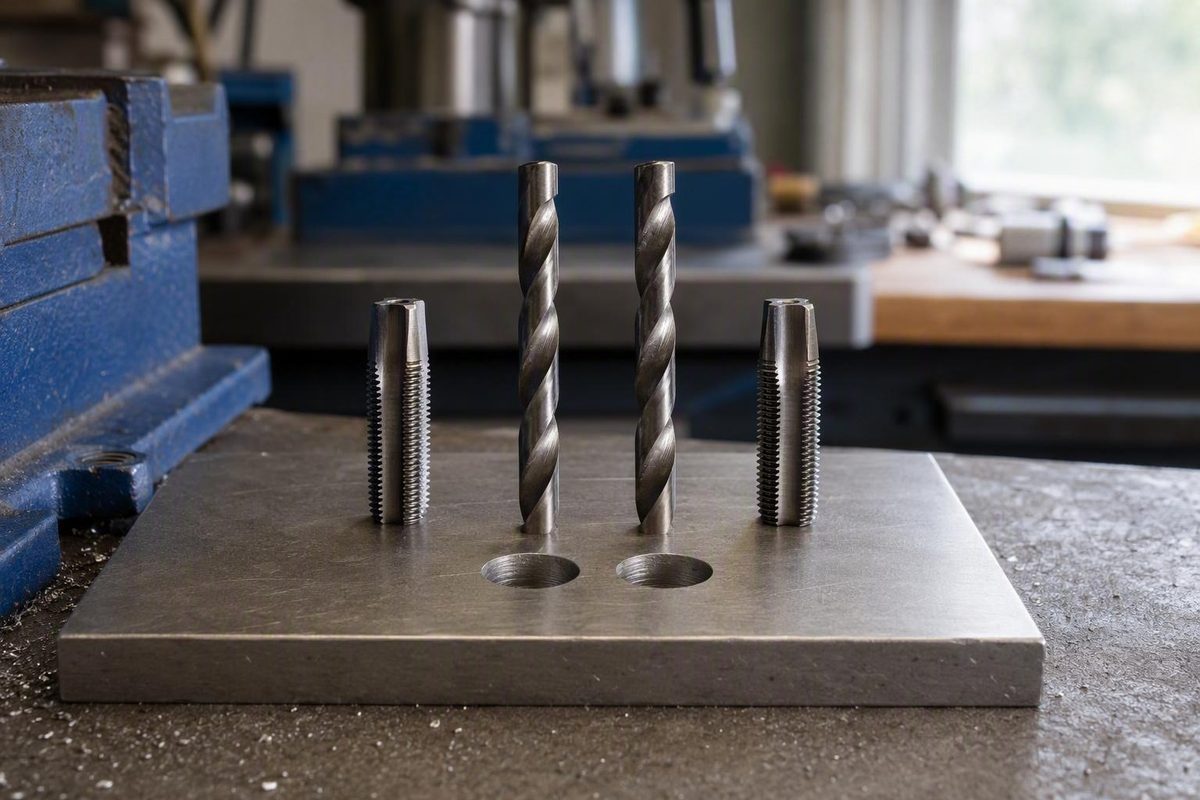
Quick answer: 9/16 inch and 37/64 inch are both published sizes
3/8-18 NPT tap-drill comparison
Published drill size Exact decimal size Where it appears 9/16 inch 0.5625 inch Tooling and engineering charts, including the Allied Machine pipe-thread chart 37/64 inch 0.578125 inch Commercial charts and matched kits, including the MISUMI NPT drill-and-tap chart Difference: 1/64 inch, or 0.015625 inch Decision rule: Use the drill recommendation supplied for your actual tap and documented process. Confirm whether that process includes a taper pipe reamer.
The full thread designation is 3/8-18 NPT, and the cited charts identify it as an 18-threads-per-inch pipe thread. The two published starting sizes differ as follows:
- 9/16 inch = 0.5625 inch
- 37/64 inch = 0.578125 inch
- 37/64 − 9/16 = 1/64 inch
- 1/64 inch = 0.015625 inch
That difference is small enough to make the recommendations look interchangeable, but the available references do not establish that they are interchangeable for every tap. Several commercial charts and purpose-built tap-and-drill kits pair a 3/8-18 NPT tap with a 37/64-inch bit. Other tooling and engineering charts specify 9/16 inch.
The references also conflict about reaming. Some describe 9/16 inch as a direct-tapping size without a taper reamer, while another lists 9/16 inch when a taper pipe reamer follows and 37/64 inch when it does not. That prevents either diameter from being presented as the universal answer.
Before drilling, identify the exact tap by manufacturer and model or part number. Consult its current chart, catalog or technical support documentation and follow the recommendation that applies to the intended process. If that documentation is unavailable, seek direction from the tap manufacturer, the controlling drawing or specification, or the responsible engineering authority rather than choosing whichever generic chart appears first.
Most importantly, do not interpret “3/8 NPT” as an instruction to use a 3/8-inch drill bit. The 3/8 portion is a nominal pipe-size designation, not the required diameter of the hole before tapping.
What the 3/8-18 NPT designation means
The complete designation contains three useful pieces of information:
- 18 is the number of threads per inch.
- NPT identifies a tapered pipe thread.
The nominal 3/8 label does not describe the diameter of the pre-tap hole. Both published candidates—9/16 inch and 37/64 inch—are larger than a literal 3/8-inch hole. That reflects how the pipe thread is designated; it is not an inconsistency in the drill-size tables.
The 18-TPI portion helps distinguish the callout from conventional machine-screw threads that also begin with “3/8.” The designation must be read as a complete unit. An AutoDrill tap-drill table identifies the entry as 3/8-18 NPT and gives 9/16 inch as its drill size.
This distinction becomes important when product descriptions use conversational wording. A seller may refer loosely to drilling a “3/8-inch hole” even though the technical specifications for the same product identify the supplied drill as 37/64 inch. For example, the GlowShift 3/8-18 NPT kit specifies a 37/64-inch drill despite using less precise wording in its overview.
When preparing the job, rely on the formal thread callout and dimensional specifications rather than an abbreviated product description. The useful identification is 3/8-18 NPT, not merely “3/8 pipe” or “a 3/8-inch hole.”
A conventional 3/8-inch fastener chart is also irrelevant to this choice. Matching only the nominal number can lead to the wrong drill, the wrong tap or both. Confirm all three elements before selecting tooling:
- Nominal pipe-size designation
- Thread pitch
- Thread form
If the drawing or work instruction provides only “3/8” without the pitch and suffix, it does not provide enough information to distinguish this thread reliably from other possible callouts.
Why some charts say 9/16 and others say 37/64
The disagreement is easier to evaluate when the references are grouped by source type rather than counted as equal votes. A matched commercial kit, a tooling manufacturer’s table and a third-party engineering article can each document a published practice, but they do not necessarily have equal relevance to the tap in your hand.
Commercial charts and matched kits commonly use 37/64 inch
A number of retail tool charts list 37/64 inch for 3/8-18 NPT. Purpose-built kits also package a 37/64-inch drill with a tap carrying that thread designation. The Drills and Cutters NPT chart pairs a 3/8-inch NPT tap with a 37/64-inch drill and offers a corresponding set.
That pairing is meaningful evidence about the kit. If a supplier sells the two tools as a set, the listing shows that the seller intends that drill and tap to be used together for the stated application.
It does not establish that 37/64 inch is a universal ANSI or ASME requirement. A retailer’s chart or product listing documents its own recommendation or product combination; it does not automatically govern taps from unrelated manufacturers.
Multiple similar retail listings should not be mistaken for multiple independent standards. Repetition demonstrates that 37/64 inch is a common market pairing, but it does not resolve the conflict with charts publishing 9/16 inch.
Commercial charts can still be useful when they apply directly to the purchased tooling. The key is to keep the scope of the evidence clear: a kit listing supports the components and intended pairing of that kit, not every possible 3/8-18 NPT process.
Tooling and engineering charts also publish 9/16 inch
Other references list a 9/16-inch tap drill for 3/8-18 NPT. Allied Machine identifies its NPT/NPTF drill-size column as applying without a taper reamer. Fractory likewise presents 9/16 inch for direct tapping without reaming. The Fractory NPT and NPS chart lists 9/16 inch for direct tapping of 3/8-18 NPT or NPTF.
These references make it unsafe to dismiss 9/16 inch as an obvious error simply because 37/64-inch kits are readily available. If the manufacturer of the actual tap specifies 9/16 inch, that instruction has more direct relevance than the drill supplied with an unrelated retail kit.
Decimal entries also require careful reading. Some charts display 9/16 inch as 0.562 inch, although the exact fractional conversion is 0.5625 inch. Likewise, a chart may show 37/64 inch as 0.578 inch even though its exact value is 0.578125 inch. The shorter figures are rounded chart displays, not different exact drill diameters.
The fraction named in the applicable documentation should therefore remain the controlling identification when the chart gives both a fractional bit size and a shortened decimal. Do not infer a separate custom diameter merely from the omitted decimal places.
Reamer guidance conflicts too
The disagreement is not limited to the drill diameter. The references also assign the two sizes differently depending on whether a taper pipe reamer is used.
Allied Machine labels 9/16 inch as the 3/8 NPT/NPTF value without a taper reamer. Fractory also describes 9/16 inch as a direct-tapping value without reaming.
Carbide Depot presents a different process split. Its pipe-tap chart lists 9/16 inch when a taper pipe reamer follows and 37/64 inch when no taper pipe reamer is used.
The supplied references therefore contradict each of these broad statements:
- “Use 9/16 inch only when reaming.”
- “Use 9/16 inch only when tapping directly.”
- “Use 37/64 inch whenever no reamer is involved.”
None can be treated as a universal rule based on the available charts. The reaming question must instead be answered from documentation that applies to the actual tap, reamer and planned sequence.
It would also be speculation to explain the split by assigning unreported assumptions about workpiece material, tap geometry or desired engagement to each chart. Those considerations may be addressed in tool-specific documentation, but the supplied references do not quantify them or demonstrate that they caused this particular disagreement.
The defensible conclusion is narrower: both diameters are published, and the published guidance also conflicts about reaming. That is why the recommendation associated with the actual tooling and documented process should control.
How to choose the size for your tap and workflow
Use a deliberate sequence before making the hole.
1. Confirm the complete drawing callout
Verify that the drawing, part specification or fitting calls for 3/8-18 NPT. Do not stop after seeing “3/8,” and do not assume the thread form from the pitch alone.
If the callout is incomplete, clarify it before selecting the drill.
Also verify that the work instruction has not confused a nominal pipe designation with an actual hole diameter. A phrase such as “drill for 3/8 NPT” identifies the intended thread but does not, by itself, settle the conflict between the two published drill sizes.
2. Identify the exact tap
Record the tap manufacturer, product line and model or part number. Check the markings on the tool and its packaging rather than relying only on its storage location or a handwritten drawer label.
If a loose tap cannot be identified adequately, a generic chart does not become tool-specific documentation merely because it includes the same nominal thread designation. Obtain current information from the manufacturer or replace the uncertainty with identified tooling before cutting an irreversible feature.
The objective is not to find the most frequently repeated number. It is to determine which documented preparation applies to the tool that will actually cut the thread.
3. Check the tap manufacturer’s drill recommendation
Consult the manufacturer’s current chart, catalog, product documentation or technical support. Give priority to instructions that identify the tap and process you intend to use.
If the documentation specifies 9/16 inch, follow that recommendation rather than substituting the 37/64-inch drill from an unrelated kit. Conversely, if a purpose-built set contains a 3/8-18 NPT tap and a 37/64-inch bit, that pairing is relevant to the set. The MaxTow kit specifications pair those two stated sizes.
The kit does not make its included bit controlling guidance for another tap. Avoid constructing an undocumented process by combining the tap from one product, the drill recommendation from a second and the reaming instructions from a third.
If the tap maker provides several recommendations for different processes, make sure you are reading the row or note that applies to your intended workflow. Do not remove a condition from a chart and treat the remaining number as universal.
4. Determine whether a taper pipe reamer is part of the process
Separate the planned operations:
- Drill the starting hole.
- Taper ream it, if the documented process requires that operation.
- Tap the pipe thread.
- Check the completed feature by the method required for the job.
If a taper pipe reamer will be used, consult the documentation for both the reamer and the tap. The generic charts assign 9/16 inch and 37/64 inch inconsistently between reamed and direct-tapped processes, so the presence of a reamer does not resolve the choice by itself.
Confirm that the specified drill prepares the starting feature required by the reamer and that the resulting preparation is the one called for with the selected tap. Treat the drill, reamer and tap as a coordinated process rather than as independent tools chosen from unrelated tables.
If the documentation does not describe the intended combination, contact the applicable tool manufacturer or responsible technical authority. Do not infer compatibility solely because every tool carries the same nominal pipe-size label.
5. Use the specified drill rather than improvising between sizes
Once applicable documentation identifies the drill, use that size. Do not average the two published diameters or substitute a nearby bit merely because it is available.
The smaller 9/16-inch drill removes less material than the 37/64-inch drill. The source pack does not establish the resulting cutting load, thread condition or engagement for a particular tap and workpiece, so those effects should not be guessed from the diameter difference alone.
The same caution applies to rounded decimal markings. If the instruction specifies a fractional drill, use the named fractional size rather than interpreting a shortened decimal as a new target.
6. Define the scope of the finished-thread check
A tap-drill chart identifies a starting-hole recommendation; it does not provide a complete inspection procedure. This article therefore does not establish a method for demonstrating thread conformity, sealing performance or pressure capacity.
Where the finished thread is consequential, obtain the applicable requirements and checking method from the controlling drawing, quality plan, tool documentation or responsible engineering authority. The appropriate procedure is application-specific and is not supplied by the cited drill charts.
A fitting may be kept available for application-level confirmation, but do not expand that observation into a claim of standards compliance unless the controlling documentation expressly makes it the acceptance method. This article supplies no dimensional limits or gauging criteria with which to make that determination.
It also does not prescribe drilling depth, tapping depth, lubricant, cutting speed, torque, pressure rating or material-specific adjustments. Those values are not established by the evidence used here and must come from documentation applicable to the actual part, tooling and process.
NPT is not NPS: do not substitute the straight-thread drill size
NPT is a tapered pipe thread, while NPS is a straight pipe thread. Sharing a nominal pipe size does not make their hole-preparation rows interchangeable.
Pitch alone does not distinguish them in this example. The cited comparison lists both 3/8 NPT/NPTF and 3/8 NPS/NPSF at 18 threads per inch. A person who checks only “3/8” and “18 TPI” could therefore read across the wrong row while believing the callout has been confirmed.
The relevant comparison is:
| Thread callout | Thread form | Published drill size in the cited comparison |
|---|---|---|
| 3/8-18 NPT/NPTF | Tapered | 9/16 inch |
| 3/8-18 NPS/NPSF | Straight | 19/32 inch |
The Allied Machine chart lists 9/16 inch for 3/8 NPT/NPTF and 19/32 inch for 3/8 NPS/NPSF, with both entries at 18 TPI. The exact decimal comparison is:
- 9/16 inch = 0.5625 inch
- 37/64 inch = 0.578125 inch
- 19/32 inch = 0.59375 inch
The 19/32-inch straight-thread value is larger than both NPT candidates discussed here. Do not use it for an NPT feature merely because it appears beside the same nominal size and pitch on a pipe-thread chart.
Fractory also gives a general distinction in joint arrangement: it describes NPT joints as typically using thread sealant or tape and straight pipe-thread arrangements as requiring a gasket or O-ring. That description helps distinguish the thread forms, but it is not an application-specific sealing instruction. The requirements for the actual assembly must come from the applicable fitting or design documentation.
A pre-drilling verification checklist
Use this checklist before the drill touches the workpiece:
- Thread form: Is the callout definitely 3/8-18 NPT rather than NPTF, NPS, NPSF or a conventional 3/8-inch fastener thread?
- Nominal size: Have you avoided treating the nominal 3/8 designation as the required drill diameter?
- Tap identity: Do you know the tap manufacturer and exact model or part number?
- Tap-drill recommendation: Have you checked documentation for that tap rather than relying only on a generic search result?
- Reaming process: Does the documented workflow call for direct tapping or for a taper pipe reamer before tapping?
- Reamer compatibility: If using a reamer, have you checked its starting-hole requirement and the tap documentation?
- Workpiece requirements: Does the applicable documentation provide instructions for the material or intended hole preparation?
- Hole type: Is the feature blind or through, and has the required depth been established from suitable documentation?
- Finished-feature check: Has the controlling drawing, quality plan or responsible authority defined how the completed thread is to be evaluated?
- Application confirmation: Is the intended fitting available if the documented process calls for an application-level check?
Resolve these questions during planning rather than after material has been removed. Although a smaller hole may be capable of enlargement, that does not make trial and error a substitute for identifying the required process. Location, depth and finished-feature requirements may remain consequential even when the diameter can still be changed.
Stop before drilling
Do not proceed while any of the following remains unresolved:
- The complete thread form
- The identity of the tap or its drill recommendation
- Whether taper reaming is part of the process
- The required drilling or tapping depth
- The required method of checking the finished feature
This pause keeps a generic tap chart from being mistaken for the complete job specification. The chart can identify a published starting size, but it cannot supply missing requirements for an unidentified tool or part.
Common mistakes behind the 3/8 NPT hole-size question
Mistake 1: Drilling a literal 3/8-inch hole
The nominal number in a pipe-thread designation is not the pre-tap drill diameter. Neither published candidate discussed in this guide is a 3/8-inch drill.
Read the entire callout and match it to the documentation for the tap.
Mistake 2: Calling 37/64 inch universally correct
The 37/64-inch size appears in commercial charts and matched kits. That makes it a common published pairing, not a universal requirement.
A kit documents what the seller supplied for that tool combination. It does not override instructions for another manufacturer’s tap or a process that includes different preparation.
Mistake 3: Calling 9/16 inch universally correct
The same limitation applies to 9/16 inch. Several tooling and engineering charts publish it, including direct-tapping tables, but the evidence does not establish that it is mandatory for every 3/8-18 NPT tap.
Use it when the documentation applicable to the actual tooling and workflow specifies it.
Mistake 4: Assuming every chart treats reaming the same way
Some references describe 9/16 inch for direct tapping without reaming. Another assigns 9/16 inch to a hole followed by a taper pipe reamer and 37/64 inch to preparation without that reamer.
Do not convert one chart’s process note into a universal rule. Check the drill, reamer and tap as a documented tool chain.
Mistake 5: Using the 19/32-inch NPS/NPSF value
The 3/8-18 NPS/NPSF row can look deceptively similar because it shares the nominal size and pitch. Its 19/32-inch drill belongs to the cited straight-thread entry, not the NPT recommendation.
Verify the complete suffix before reading across the chart.
Mistake 6: Treating rounded decimals as exact conversions
Some charts shorten 9/16 inch to 0.562 inch. The exact conversion is 0.5625 inch. Similarly, 37/64 inch may be displayed as 0.578 inch even though its exact value is 0.578125 inch; the published AutoDrill table illustrates the shortened decimal used for 9/16 inch.
Those shortened values are rounded displays. Use the stated fractional drill size when that is what the applicable documentation specifies.
Mistake 7: Assuming the starting drill guarantees the finished result
Neither candidate drill size, by itself, demonstrates sealing performance, pressure capacity, specified engagement or conformity. A tap-drill chart addresses the starting hole, not every subsequent operation or acceptance requirement.
The concise rule is:
Identify the full thread, match the drill to the actual tap and documented process, and check the finished thread as required for the job.
Frequently asked questions
Is 37/64 inch the standard drill size for a 3/8-18 NPT tap?
It is a commonly published size, but the available evidence does not establish it as the single universal size. The MISUMI chart lists 37/64 inch, displayed as 0.578 inch, for a 3/8-inch NPT tap at 18 TPI, while other tooling charts specify 9/16 inch.
Treat 37/64 inch as applicable when it is the documented recommendation for your tap and process. A drill supplied in an unrelated kit does not govern every other tap carrying the same thread designation.
When would a 9/16-inch drill be used for 3/8 NPT?
Use 9/16 inch when the documentation for the actual tap and intended workflow specifies it. Published sources disagree about the associated process: some present it for direct tapping without a reamer, while the Carbide Depot chart assigns 9/16 inch to preparation followed by a taper pipe reamer.
Because of that conflict, do not assume that 9/16 inch always means either direct tapping or reaming. Consult the tap documentation and, if applicable, the reamer documentation.
Is a 3/8 NPT hole drilled with a 3/8-inch bit?
No. In the designation 3/8-18 NPT, 3/8 is a nominal pipe-size label rather than the diameter of the pre-tap hole.
The published candidates discussed in this guide are 9/16 inch and 37/64 inch. Determine which one applies from documentation for the selected tap and process rather than from the nominal 3/8 label.
What is the difference between 3/8 NPT and 3/8 NPS hole sizes?
NPT is tapered, while NPS is straight. The cited 3/8 entries both use 18 threads per inch, so nominal size and pitch alone do not make them interchangeable.
In the Fractory comparison, 3/8-18 NPT/NPTF uses a 9/16-inch drill for direct tapping, while 3/8-18 NPS/NPSF uses 19/32 inch. Keep that straight-thread value separate from both NPT candidates.
How deep should a 3/8-18 NPT hole be drilled and tapped?
The cited tap-drill charts do not establish a drilling or tapping depth. The required depth must come from documentation applicable to the part and tooling, such as the controlling drawing, tap manufacturer’s instructions or responsible engineering direction.
This guide also does not supply blind-hole clearance, cutting speed, lubricant, tapping torque or material-specific adjustments. A drill diameter alone cannot establish those process details.
The qualified hole-size answer remains: published references list both 9/16 inch and 37/64 inch for 3/8-18 NPT, a difference of 1/64 inch. Do not choose from the nominal 3/8 label or an unrelated generic chart alone. Confirm the full thread form, follow the documentation for the actual tap and any taper pipe reamer, keep the 19/32-inch NPS value separate, and use the checking method required by the applicable job documentation.