
Silver Solder vs Bronze Brazing Rod for Steel
Compare silver brazing alloy with bronze rod for steel by joint geometry, heat limits, filler identity, and your actual filler cost per joint.
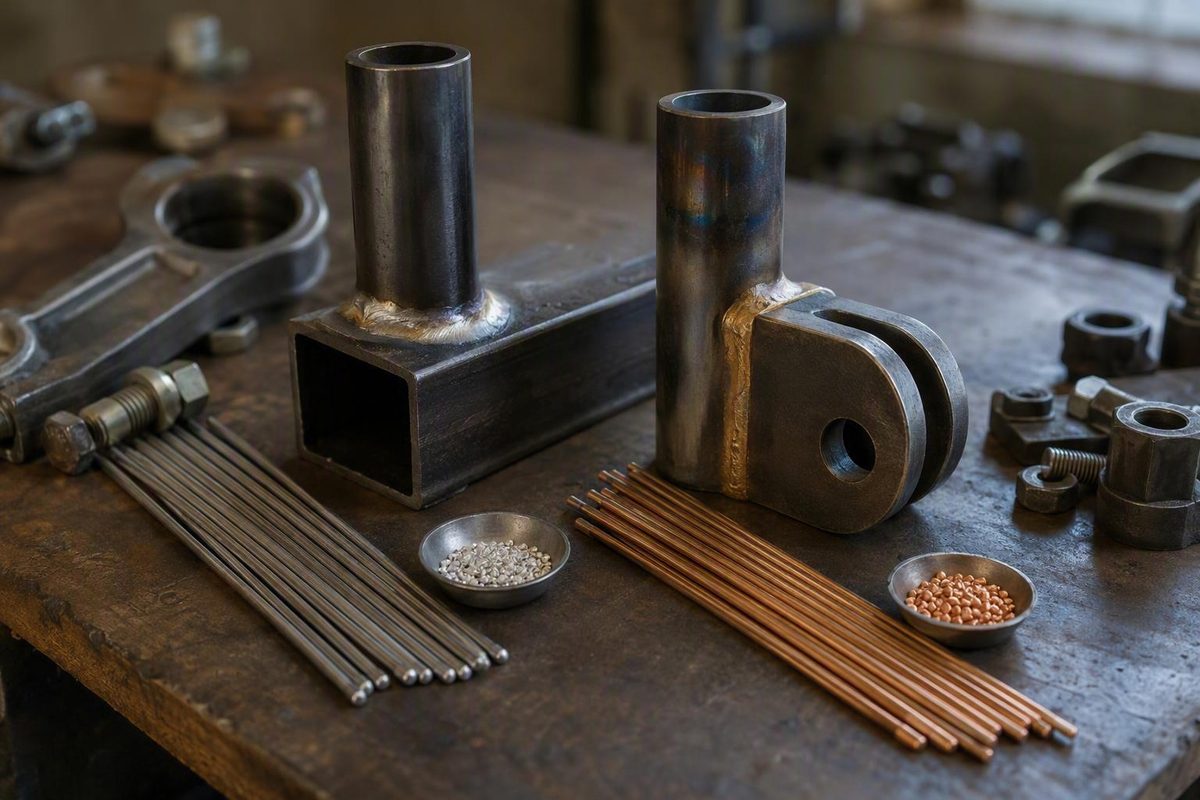
For steel, use a verified silver brazing alloy when a clean, close-fitting lap, sleeve, socket, or overlapped joint needs capillary flow—especially with thin sections, stainless steel, or parts that cannot tolerate the heat of a typical bronze filler. Use an identified low-fuming bronze or silicon-bronze filler for ordinary mild-steel butt, tee, and corner joints that need a built-up fillet. Redesign wide or irregular gaps rather than filling them with expensive silver.
Silver is not automatically stronger, and bronze is not automatically cheaper per successful joint. Geometry, filler identity, steel condition, heating cycle, loading, and filler consumption decide the result.
Enter your joint, steel, filler use, and package price; the tool returns a filler choice and cost per joint.
Classify the joint first. Then enter your own package cost and actual filler consumption; no universal retail price or standard consumption figure is available in the cited material.
| Filler Choice | Best Starting Use On Steel | Heat/Flow Character | Cost Treatment |
|---|---|---|---|
| Selected 45% silver | Close lap, sleeve, socket, thin or heat-sensitive work | Capillary; exact range depends on alloy | Package cost plus 45% silver spot floor |
| 56% silver | Close capillary joint where its datasheet approves steel | BAg-7 example: 1205°F liquidus (~652°C) | Package cost plus 56% silver spot floor |
| 15% Ag phosphorus-copper | Only where the exact product explicitly approves steel | Do not infer suitability from silver percentage | Package cost plus 15% silver spot floor |
| Low-fuming bronze | Ordinary mild-steel butt, tee, or corner fillet | Built-up fillet; verify RBCuZn identity and heat range | Package cost; commodity floor — |
| Silicon bronze | Identified fillet procedure for butt, tee, or corner | Cited C2 example ~875°C; not category-wide | Package cost; commodity floor — |
Decision rule: capillary geometry, thin material, stainless, or constrained heat points toward verified silver; ordinary mild-steel fillets point toward an identified bronze filler; wide gaps, unknown steel, and altered-hardened parts require redesign or an alloy-specific assessment.
Source note: Comex silver settlement of $68.636/troy oz from the cited August 25, 2026 Dow Jones market-data report; temperatures and alloy percentages are the examples stated in the article. Retail package costs and filler consumption are user-supplied. “—” means the evidence does not provide a defensible value.
The calculator uses your package price because the available sources do not provide comparable retail prices or a standard quantity of filler consumed per joint. Without those figures, a defensible universal dollar-per-joint comparison is not possible.
Silver Belongs In Close-Fitting, Heat-Sensitive Joints
The useful distinction is between a capillary joint and a built-up fillet.
A silver brazing alloy is generally the better starting point for:
- A lap with controlled clearance and adequate overlap
- A sleeve or socket with a consistent annular gap
- Closely overlapped sheet edges
- Thin parts vulnerable to distortion
- Stainless steel, provided the alloy and flux are approved for it
- Hardened or heat-sensitive parts, but only after checking the permitted thermal cycle
Molten silver alloy can move through a narrow interface and distribute filler over a larger bonded area. That behavior is valuable only when the joint was designed for it. A line of silver around the entrance does not prove complete internal fill, and fluid filler cannot compensate for inadequate overlap.
A square butt joint presents only the two end faces. If silver is otherwise attractive, change the geometry by adding a sleeve, machining a socket and spigot, creating a lap, or using a scarfed or stepped interface. Required overlap and wall thickness must come from manufacturer guidance, representative testing, or engineering for the actual load.
Low-fuming bronze or an identified silicon-bronze filler is generally more practical when an ordinary mild-steel joint needs a visible fillet across a butt, tee, or corner. The filler is deposited at the surface intersection rather than drawn through a long capillary interface.
That does not make every product labeled “bronze rod” suitable. Fillet dimensions, wetting, defects, load direction, steel condition, and the exact filler still control the joint. The available sources do not provide matched tests from which to prescribe universal fillet dimensions or rank every bronze filler against every silver alloy.
“Silver Solder” May Not Be A Brazing Alloy
Under the American Welding Society distinction reported by EWI, brazing uses filler with a liquidus above 450°C (842°F). Soldering uses filler with a liquidus at or below that threshold. Both melt the filler without melting the steel components, but they are not interchangeable processes (EWI’s explanation of soldering and brazing).
“Silver solder” may therefore mean a low-temperature silver-bearing soft solder, a high-temperature silver brazing alloy, or an unidentified product called hard solder. A small silver content does not make soft solder equivalent to a BAg brazing alloy.
“Bronze rod” is equally incomplete. It may refer informally to silicon bronze, an RBCuZn copper-zinc brazing filler, brass rod, or a product intended for braze welding. Those names do not establish identical composition, working range, flow, joint form, or safety requirements.
| Package Label | Possible Product | Required Check |
|---|---|---|
| Silver solder | Soft solder or silver braze | Liquidus and designation |
| BAg alloy | Silver brazing filler | Full BAg suffix and datasheet |
| Silicon bronze | Copper-silicon filler | Process and steel approval |
| Bronze or brass rod | Possibly RBCuZn | Exact composition and flux |
Before buying, obtain the manufacturer part number or AWS designation, composition, solidus and liquidus, approved base metals, recommended flux, clearance or joint-form guidance, technical datasheet, and current safety data sheet. An unidentified inherited rod is not adequate design information.
This matters particularly for 15% silver phosphorus-copper filler. Silver percentage alone does not establish suitability for steel. Use it only if the exact product documentation approves the base metal and procedure.
Silver’s Lower Working Temperature Can Protect The Part
The following figures are product examples, not specifications for entire filler categories. The first four are approximate “melting temperature” figures reported by one retailer, which does not say whether each is a solidus, liquidus, or another nominal temperature (Welders Warehouse’s comparison).
| Filler Example | Reported Temperature | Practical Meaning |
|---|---|---|
| 33% silver | ~720°C | Silver content alone is insufficient |
| 40% silver | ~675°C | Silver alloys have different ranges |
| 55% silver | ~650°C | Below the cited C2 example |
| C2 silicon bronze | ~875°C | Higher than these silver examples |
| BAg-7, 56% silver | 1205°F liquidus, ~652°C | Named alloy with stated liquidus |
The BAg-7 value comes from a separate commercial discussion of silver brazing alloys (Carbide Processors on BAg fillers).
These examples explain why silver is often retained for thin, stainless, hardened, or heat-sensitive assemblies despite its price. A filler reported near 650°C can offer a substantially different heating cycle from the cited silicon-bronze product near 875°C.
That comparison does not prove every copper-base filler causes more distortion. Torch output, assembly mass, dwell time, access, fixtures, local overheating, steel composition, and prior heat treatment affect total heat exposure.
Identify whether the component is mild steel, stainless, tool steel, case-hardened, galvanized, painted, plated, or attached to bearings, seals, electronics, or other heat-sensitive parts. Brazing heat may alter hardness or temper in some steels. Coatings can create separate contamination and safety problems.
If preserving the part’s condition matters more than filler price, select the thermal cycle first. For a hardened or unknown component, general workshop guidance cannot establish that either process is acceptable.
Capillary Clearance Must Match The Named Silver Alloy
Close and consistent clearance supports capillary action. Excessive clearance can stop a selected silver alloy from filling as intended, while an open or irregular joint may require redesign or a qualified fillet-forming process.
Informal shop sources illustrate the scale without establishing a universal specification. One hobby-machining contributor suggested approximately 0.002 inch for a silver-brazed joint (Hobby-Machinist discussion of fit and technique). Another beginner guide cited in the research gave 0.002–0.005 inch without qualifying the range by named filler, steel, or joint design.
Those figures show only that capillary clearances may be measured in thousandths of an inch. Use the clearance specified for the exact filler, steel, joint arrangement, and heating method.
A wide gap should not be repaired by feeding additional silver. Silver is usually the costliest choice for using filler as metallic putty, and the resulting bead does not create a defined load path.
Commodity Prices Explain The Increase, Not Your Joint Cost
Front-month Comex silver settled at $68.636 per troy ounce on August 25, 2026 (Morningstar’s Dow Jones market-data report). The topic data reports that this was 77.9% above a year earlier and followed a 19% August rise, after silver reached a $115 record in January. Historical spot charts provide context for that movement (JM Bullion’s silver-price chart).
That rise puts direct pressure on 45% and 56% silver filler, but the futures settlement is not a retail rod quotation. Manufactured filler also includes other alloying metals, processing, drawing, packaging, distribution, and supplier margin. The supplied sources contain no matched year-over-year retail package series proving an exact doubling for every silver rod.
Copper pricing also affects bronze fillers. Record copper pricing, premiums, and tariff concerns can raise costs without establishing the future price of a particular silicon-bronze or RBCuZn rod (CNBC’s report on copper markets and tariffs).
The reliable comparison is your invoice cost per usable quantity. The direct filler-cost formula is package price divided by package mass, multiplied by filler mass consumed per joint. Add flux, fuel, preparation, machining, fixturing, heating time, cleanup, inspection, failed joints, and rework when comparing the completed operation.
The calculator also reports contained-silver value when filler use is entered in troy ounces. That result is a commodity-metal floor, not a predicted rod price. It intentionally gives no metal-floor figure for low-fuming bronze or silicon bronze because the supplied evidence does not provide the necessary alloy composition and copper price on a consistent basis.
Heat The Joint Instead Of Melting Rod In The Flame
For open-air torch brazing, clean the mating steel to bare sound metal, establish the specified fit, apply compatible flux where required, and fixture the assembly without obstructing the heat path.
Bring the steel around the joint into the filler’s working range. The heated work should melt the filler on contact. If the flame melts droplets from the rod while the steel remains too cold, the filler may ball up or sit on the surface without wetting.
For capillary work, distribute heat along the intended flow path. If one member is heavier, it normally demands more heat than the lighter member. A fixture can also draw heat away and prevent the complete interface from reaching temperature.
Flux must be compatible with the filler and remain active through its working range. A low-temperature soldering flux can be exhausted before a high-temperature silver brazing alloy becomes fluid. Flux assists oxide control and wetting, but it cannot replace degreasing, mechanical cleaning, or correct fit.
After heating, follow the cooling procedure for the actual steel and filler. Do not assume quenching or air cooling is universally correct. Remove flux residue by the specified method; EWI notes that some residues can contribute to corrosion or abrasive wear in some applications.
Poor Flow Usually Points To Fit, Flux, Or Heat
| Symptom | Likely Cause | Corrective Direction |
|---|---|---|
| Filler balls up | Dirt, oxide, wrong flux, cold steel | Stop, clean, verify flux, heat work |
| Partial penetration | Bad clearance or uneven heat | Check fit and entire heat path |
| Burned, glassy flux | Local overheating or long dwell | Spread heat or improve capacity |
| Heavy external buildup | Interface did not accept filler | Correct fit; do not conceal it |
| Gaps after cooling | Movement, poor fit, incomplete flow | Refixture, redesign, or use fillet |
If filler enters one side but not the full interface, check whether the path is continuous, both members reached the working range, flux covered the mating surfaces, the fixture is acting as a heat sink, and filler was fed at an effective location.
After cooling and cleanup, inspect for skipped areas, cracks, porosity, movement, incomplete wetting, and underfill. Visual inspection cannot prove complete internal capillary fill.
For an unfamiliar combination, make representative coupons from the actual steel. Reproduce the geometry, clearance, filler, flux, torch, orientation, and cooling method. A useful mechanical test must also reproduce the real load path.
Neither Filler Has A Universal Strength Advantage
The available evidence does not support a category-wide ranking for tensile strength, shear strength, fatigue life, impact resistance, vibration, corrosion, or maximum service temperature.
A meaningful comparison requires exact filler alloys, steel grade, surface condition, overlap or fillet dimensions, loading direction, heating cycle, flux, cleanup procedure, defects, test method, and service environment. Published filler-metal strength alone cannot account for inadequate bonded area, incomplete wetting, altered steel, or a poorly directed load.
Silver should therefore earn its higher cost by solving a particular problem: capillary distribution, lower filler temperature, thin material, stainless compatibility, or reduced thermal exposure. For routine mild-steel fillets with adequate heat tolerance, an identified low-fuming bronze or silicon-bronze product is normally the more economical starting point.
Old silver filler needs special scrutiny. The cited commercial technical article identifies BAg-3 as cadmium-bearing and warns about inhalation. Check the current SDS for every filler and flux, especially inherited stock. Coated steel and hot-work conditions require their own controls.
A structural, pressure-containing, lifting, vehicle, or other safety-critical repair cannot be approved from this comparison. Use the governing design requirements, qualified procedure, inspection method, and application-specific engineering.