
Trailer Wheel Bolt Torque: How to Find the Spec
Identify the axle, hub, wheel, fastener arrangement, seat style and thread condition, then verify torque, sequence and recheck timing.
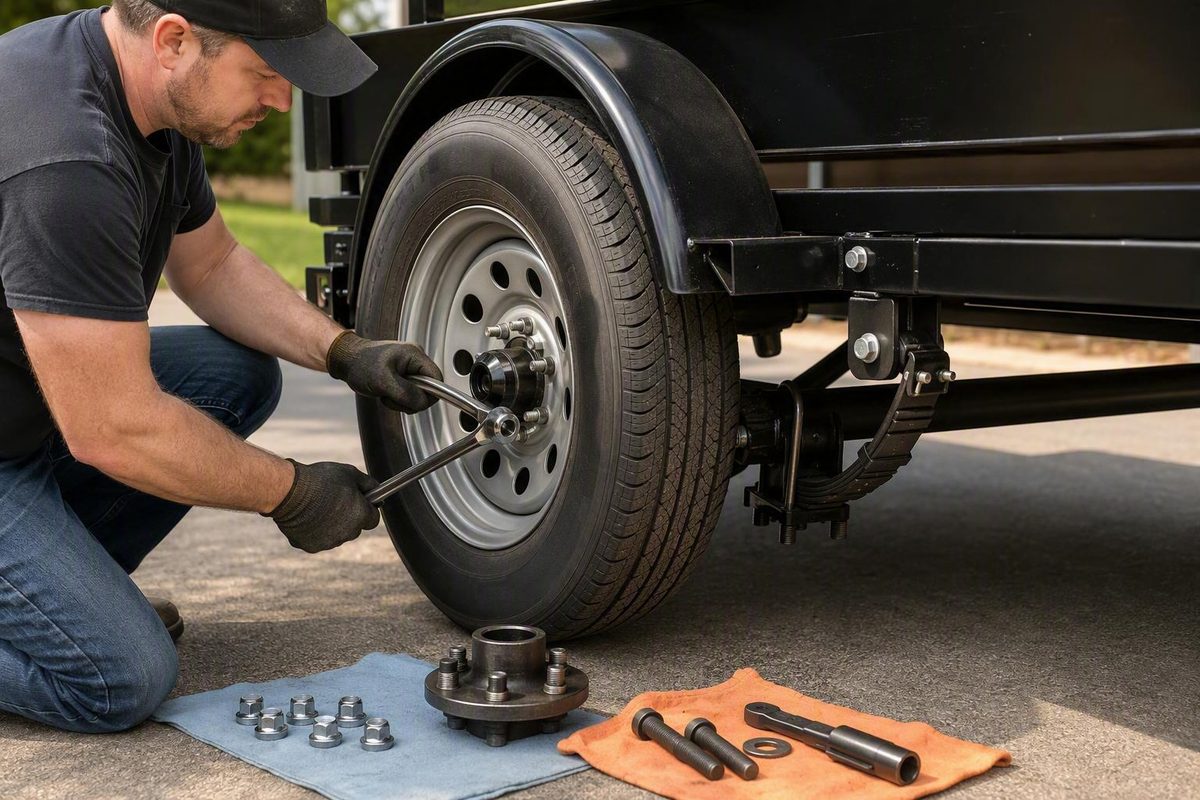
There is no verified universal trailer wheel bolt torque. Identify the complete assembly, obtain the applicable manufacturer documentation, and verify the torque value, tightening sequence, thread condition, and recheck schedule before tightening.
Start here: do not use a universal torque number
Do not select trailer wheel-fastener torque by diameter alone. A value for one configuration is not automatically valid for another.
General tables depend on stated assumptions about fastener class, material, thread condition, and joint design. The Independent Scratch Builder’s general bolt-torque guide likewise says manufacturer specifications override its baseline values; it provides no trailer-, axle-, hub-, or wheel-specific torque.
Begin by identifying the fastening arrangement:
- Wheel bolts: Removable bolts pass through the wheel and thread into the hub.
- Wheel studs with lug nuts: Fixed studs project from the hub, and separate nuts secure the wheel.
Do not treat the two arrangements as interchangeable. Record the installed bolt or nut dimensions, seat style, wheel type, and component identification before searching for a specification.
Use this identification checklist before looking up a specification
Collect the following information at the workbench:
- [ ] Trailer manufacturer, model, and year
- [ ] Trailer VIN
- [ ] Axle manufacturer and model
- [ ] Axle rated capacity
- [ ] Hub model, casting number, or other identification
- [ ] Wheel material: steel or aluminum
- [ ] Wheel size and identifying markings
- [ ] Fastener arrangement: wheel bolts or studs with lug nuts
- [ ] Fastener diameter
- [ ] Thread pitch
- [ ] Nut or bolt seat style
- [ ] Required thread condition
- [ ] Whether the wheel, hub, or fasteners differ from the original equipment
Start with the axle identification tag. Inspect the wheel markings and hub for model numbers, capacity markings, or part identification, then compare them with the trailer’s VIN documentation, owner’s manual, certification information, and parts records.
A value for another axle capacity, a steel wheel instead of an aluminum wheel, a different seat style, or another fastener arrangement is not verified for the installed equipment.
Capacity boundaries are firm. The limited Dexter manual example used here is labeled for axles rated from 9,000 through 15,000 pounds. It therefore does not establish requirements for a 16,000-pound axle or another axle outside that stated range.
Thread condition is also part of the specification. Record whether the applicable instructions call for dry, lubricated, or otherwise prepared threads. Do not automatically add oil or anti-seize—or assume that the specification requires dry threads—without instructions for the identified assembly.
Follow a source hierarchy, not a generic chart
Treat the following as documents to cross-check, not as a universal order of precedence:
- The trailer manufacturer’s owner or service manual for the exact model and year
- Official axle documentation for the identified model and capacity
- Official wheel and hub instructions for the installed components
- Written clarification from the relevant manufacturers when documentation is incomplete or inconsistent
The Dexter manual copy used for the bounded example below tells readers to consult the vehicle manufacturer’s owner’s manual for additional procedures and warnings. Its table of contents identifies wheel torque requirements on page 75 and the wheel torque sequence on page 76, but the excerpt itself does not provide those substantive instructions.
Accordingly, the excerpt cannot supply a numeric Dexter torque or tightening pattern. Before working on an applicable Dexter assembly, obtain a complete, current official manual that matches the axle model and capacity, then verify its revision, wheel requirements, sequence, and any related vehicle-manufacturer instructions.
If apparently applicable documents conflict, stop and recheck the axle model, capacity, wheel material, hub, fasteners, and manual revisions. Ask the relevant trailer, axle, wheel, or hub manufacturers to clarify which instruction applies rather than choosing the higher, lower, or more convenient value.
Treat torque, sequence, and recheck timing as three separate instructions
A torque number answers only one part of the job. Record three distinct requirements before tightening:
| Instruction | What to record | What not to assume |
|---|---|---|
| Numeric torque | Exact value and units, such as ft-lb or N·m | That a value for similar hardware applies |
| Tightening sequence | Prescribed order and any staged passes | That every wheel uses the same star or cross pattern |
| Recheck schedule | Mileage, elapsed time, and triggering events | That reaching final torque ends the requirement |
Use only the tightening order and stages stated for the identified assembly; do not present a familiar star or cross pattern as universally correct for trailer wheels.
Likewise, a published torque value does not by itself say when the fasteners must be checked again. Initial installation, recent wheel service, and periodic maintenance may be addressed separately in the applicable documentation. Record the schedule associated with the specification rather than relying on memory or a schedule for another axle.
Final acceptance must be based on the documented specification and the measurement method required for the assembly.
Dexter example: what the available excerpt does—and does not—establish
This is a limited documentation example, not a universal schedule. It concerns a manual described as covering Dexter axles rated from 9,000 to 15,000 pounds.
The excerpt describes wheel-nut torque checks on new axles at 10, 25, and 50 miles. It also lists tightening wheel nuts and bolts to their specified values at three months or 3,000 miles as a recurring maintenance entry. The same document identifies page 75 for wheel torque requirements and page 76 for the torque sequence, but the excerpt provides neither the numeric torque table nor the actual sequence. These details come from a third-party-accessed manual copy, so verify them in a direct, current official copy before treating them as instructions for an axle.
Do not extend this example to a 16,000-pound axle, another Dexter product family, or another manufacturer’s equipment. It demonstrates why document scope matters; it does not provide a torque specification for configurations beyond that scope.
A practical lookup worksheet
Complete this record before tightening the wheel:
| Field | Recorded information |
|---|---|
| Trailer manufacturer, model, and year | |
| Trailer VIN | |
| Axle manufacturer and model | |
| Axle rated capacity | |
| Hub identification | |
| Wheel material and markings | |
| Fastener type | Wheel bolts / studs with lug nuts |
| Fastener diameter and thread pitch | |
| Seat style | |
| Specified thread condition | |
| Torque value and units | |
| Tightening sequence and stages | |
| Recheck interval | |
| Source title | |
| Source URL | |
| Manual revision or publication number | |
| Page number | |
| Date installed or serviced |
For example, suppose the axle tag identifies a 16,000-pound axle. The Dexter manual described above stops at 15,000 pounds, so it is out of scope even if the wheel and fasteners appear similar. The next step is to obtain documentation expressly covering the identified 16,000-pound axle and installed wheel assembly, not to extrapolate from the lower-capacity material.
Apply a clear stop-work rule: if you cannot identify the assembly or verify the applicable official specification, do not invent a value from a generic table. Resolve missing identification, conflicting component information, damaged hardware, replacement-part uncertainty, or unclear instructions before continuing.
After wheel service, record the source title, revision, page, torque value, sequence, thread condition, and recheck interval with the maintenance entry. This provides a traceable basis for the next check and helps prevent an obsolete specification from being reused after a component change.
Can I use a standard bolt-torque chart for trailer wheel bolts?
No. A standard chart supplies baseline values under limited assumptions, not a specification for a complete trailer wheel assembly. Use documentation that expressly covers the installed axle, hub, wheel, fastener arrangement, dimensions, seat style, and required thread condition.
Does the cited Dexter guidance apply to a 16,000-lb axle?
No. The manual’s stated capacity range ends below 16,000 pounds, so it does not establish the torque, sequence, or recheck schedule for that axle. Obtain official documentation for the exact axle and wheel configuration.
Should trailer wheel-fastener threads be dry or lubricated?
Use the condition expressly stated by the applicable manufacturer. Do not assume the threads should always be dry, oiled, or coated with anti-seize. Thread condition changes the relationship between applied torque and clamp force, which is why the manufacturer’s specified condition must govern.