
Are Welding Machine Parts Under Section 232 Tariff?
See which welding parts and gas cylinders BIS proposed for Section 232 duties, calculate the scenario, and decide what a home shop should buy now.
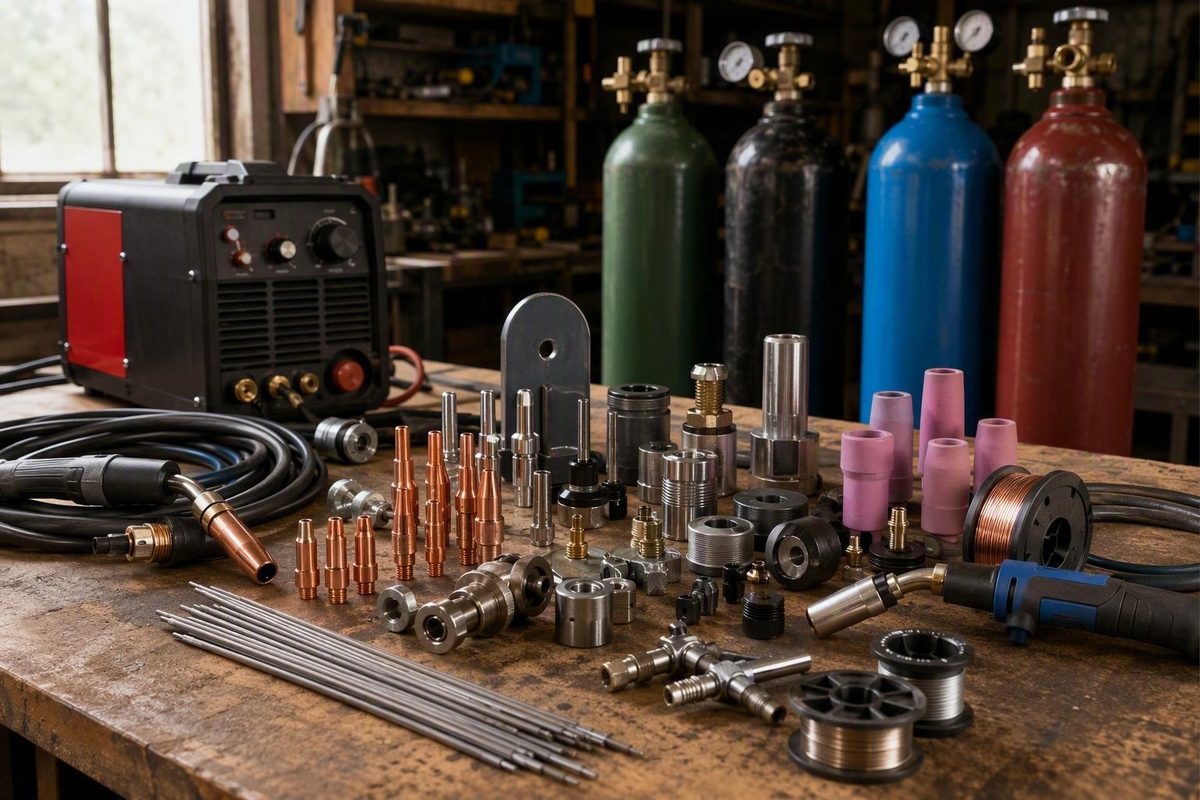
As of August 26, 2026, parts classified under HTSUS 8515.90.2000 are proposed—not yet shown as finally subject—to a 25% Section 232 duty on their full customs value. The same proposal would charge 50% on the container value of filled oxygen and propane cylinders. Complete welders, welding wire, rod, and the gas itself are not named in this proposal, although another tariff provision could still cover a particular product.
Choose the item, origin, and value to calculate the proposed-duty scenario.
This calculates the August 2026 proposal only. It does not calculate ordinary duty, Section 301, antidumping, countervailing duties, freight, or retail markup.
Wire feeder: potentially within the proposed parts line
Enter a value to estimate 25%
Planning basis: 25% of full customs value if classified under HTSUS 8515.90.2000 and the proposal is implemented.
Classification must be verified. “Wire feeder” is a commercial description, not a tariff determination.
| Shop Item | Proposal Status | Rate | Duty Base | Shop Decision |
|---|---|---|---|---|
| Wire feeder | Potential welding-machine part | 25% | Full customs value | Verify 8515.90.2000; consider buying a known-fit spare |
| Welding torch | Potential welding-machine part | 25% | Full customs value | Verify classification; buy early if it is a planned replacement |
| Torch liner | Potential welding-machine part | 25% | Full customs value | Low-storage replacement worth reviewing before a final rule |
| Contact tips | Potential welding-machine part | 25% | Full customs value | Verify whether classified as a machine part or consumable |
| Complete welder | Not named in welding-parts addition | 0% from this proposal | — | Do not replace a working machine solely because of this proposal |
| Filled oxygen-cylinder swap | Proposed cylinder category | 50% | Container value only | Ask for the container value; gas remains outside this proposed duty |
| Filled propane cylinder | Proposed cylinder category | 50% | Container value only | Separate container value from fuel value before estimating |
| Welding cable | Not established by supplied evidence | — | — | Classify as cable or another article before checking Section 232 |
| Fire extinguisher | Not established by supplied evidence | — | — | Do not treat it automatically as an oxygen or propane cylinder |
“0% from this proposal” does not mean duty-free. Another Section 232 provision or another customs duty may apply.
Source: BIS request for comments published August 6, 2026, docket BIS-2026-0331, and the cited legal analysis. Status shown is as of August 26, 2026; proposed duties are not shown as final or effective.
For a home shop, the sensible advance purchases are dedicated replacement parts you already expect to need: a known-fit torch, wire-feed mechanism, liner, or contact tips. Do not replace a functioning complete welder merely because of this proposal. Complete machines are outside the proposed welding-parts line, and consumable wire and rod are not added by it.
Filled oxygen or propane cylinders deserve a separate calculation because the proposed 50% rate applies to the container value, not the gas. A cylinder swap price does not necessarily reveal that value, so the added cost cannot be calculated from the total swap charge alone.
The Bureau of Industry and Security published the August 6 request for comments under docket BIS-2026-0331. Comments are due August 27, 2026. The notice requests comments; it does not itself make the additions effective.
The Proposed Duties Have Not Taken Effect Yet
The August 2026 action covers 14 proposed derivative-product categories involving aluminum, steel, and copper. The welding-shop items fall into two distinct groups:
| Proposed category | Proposed rate | Duty base | Current status |
|---|---|---|---|
| Welding-machine parts, HTSUS 8515.90.2000 | 25% | Full value | Proposed |
| Filled oxygen cylinders | 50% | Container value | Proposed |
| Filled propane cylinders | 50% | Container value | Proposed |
The legal analysis of the BIS proposal identifies HTSUS 8515.90.2000 for parts of welding machines and apparatus. The proposal does not establish a current entry liability, effective date, or Chapter 99 filing instruction for those parts.
The procedural record is:
| Status Item | August 2026 Position |
|---|---|
| Public inspection | August 4, 2026 |
| Federal Register publication | August 6, 2026 |
| Comment deadline | August 27, 2026 |
| Docket | BIS-2026-0331 |
| Legal status | Proposed, not shown effective |
Expiration of the comment period will not by itself activate the duties. A later controlling action would need to identify the products adopted, rate, duty base, effective date, applicable HTSUS and Chapter 99 provisions, and any transition rules. CBP would then issue or update entry instructions.
Anyone reading after August 26, 2026 should check for that later action rather than treating this dated status as current. The controlling date normally concerns when merchandise is entered for consumption or withdrawn from warehouse for consumption, as specified by the relevant action—not when a home-shop buyer placed an order.
Buy Known-Fit Replacement Parts, Not General Stock
A proposed 25% duty is a reason to review planned repairs, not to fill every drawer in the shop.
Buy before implementation when all three conditions are true: the component is a dedicated part likely to fall under HTSUS 8515.90.2000, it fits equipment you intend to keep, and replacement is reasonably foreseeable. A torch assembly, feeder mechanism, liner, or machine-specific contact tip may meet those conditions, but its actual classification still must be verified.
Avoid speculative purchases of circuit boards, transformers, welding cable, connectors, sheet-metal housings, brackets, or generic hardware. Their function and construction may place them under classifications other than 8515.90.2000. Some could already be covered by another Section 232 measure; others may remain outside this proposal.
Replacement fasteners and hardware should not be treated as welding-machine parts merely because they came from a welder. General-purpose fasteners normally require analysis under their own tariff provisions.
There is less reason to accelerate these purchases solely because of the August proposal:
- A complete welding machine
- Welding wire or rod
- Consumable electrodes
- Oxygen or propane gas without the cylinder
- An item whose classification is unresolved
These products are not named by the proposed welding-parts addition. That does not guarantee freedom from every existing customs duty or trade measure.
A retail customer also should not assume that a 25% customs duty produces an identical 25% shelf-price increase. The importer pays the duty, while the eventual price can reflect existing inventory, contracts, margins, freight, sourcing, and other costs. The supplied evidence contains no reliable forecast of retail price changes.
“Welder Part” Is Not a Customs Classification
Section 232 coverage is tied to HTSUS classifications, proclamation annexes, and Chapter 99 provisions. A product name on an invoice, marketplace listing, or manufacturer’s parts diagram does not settle the classification.
A complete welder, a machine-specific replacement part, an accessory, and a consumable can have different tariff treatment. The same applies to parts within one machine. A wire feeder moves consumable wire, a power module regulates electricity, a cable carries current, and a steel panel forms an enclosure. Installation in the same welder does not put all four under one tariff line.
Classification may depend on:
- The article’s primary function and physical construction
- Whether it has a separate electrical or mechanical identity
- Its materials and manufacturing method
- Whether it is dedicated to a particular machine
- Electrical specifications, insulation, fittings, and connections
- How the tariff schedule describes the finished article
A supplier’s tariff number can help start the review, but it is not a binding determination. Neither is a manufacturer’s SKU, an internal commodity code, an earlier informal shipment, or software that assigns a code from a short product description.
The reliable sequence is to classify the imported article first and then compare that classification with the Section 232 provisions in force on the relevant entry date. CBP’s Section 232 steel and aluminum FAQs provide general implementation information, but the applicable proclamation, annexes, HTSUS, and entry instructions control.
Cylinder Duties Use the Container Value
The proposed treatment of filled oxygen and propane cylinders differs from the welding-parts rule. The proposed rate is 50% of the container value.
The calculation is: proposed cylinder duty equals container value multiplied by 0.50.
If an invoice states only one combined amount for a cylinder exchange, gas, handling, and other charges, the supplied evidence does not provide a method for extracting the container value. Ask the supplier or importer what value is being assigned to the container. Do not multiply the entire swap charge by 50% unless the controlling rule and valuation records support that base.
The gas itself remains outside this proposed cylinder duty. That distinction matters for leased cylinders and exchange programs, where the customer may be paying for gas and service without purchasing the container outright.
A fire extinguisher should not be treated automatically as an oxygen or propane cylinder. The evidence supplied here does not establish its classification or treatment under the proposal. Its contents, construction, function, and tariff classification would need separate review.
Another Section 232 Provision May Already Apply
The pending status of HTSUS 8515.90.2000 does not prove that every welding-related component is currently outside Section 232. A product classified as an electrical article, cable assembly, fastener, metal article, or other derivative may already fall within a different annex.
This is especially relevant for formed metal enclosures, cable assemblies, connectors, hardware, and general-purpose components. Their existing treatment cannot be determined from the fact that they are sold for use with a welder.
CBP’s April 2026 guidance also describes a specific low-metal-weight rule. Qualifying annex-listed goods outside HTSUS Chapters 72, 73, 74, and 76 containing less than 15% applicable metal by aggregate weight receive a 0% additional rate under the specified provision. The applicable metals depend on the classification and the listed paragraphs of Annex IV. See CBP’s April 2026 implementation guidance.
That is not a blanket exemption for welding parts. It applies only when the product, annex, classification, metals, entry date, weight calculation, and Chapter 99 reporting satisfy the instructions. A bill of materials and credible component weights may be needed to support the treatment.
Section 232 can also operate alongside ordinary customs duties, Section 301 tariffs, and antidumping or countervailing duties. The Congressional Research Service overview describes a framework containing multiple annexes and possible rates rather than one universal metals tariff.
Calculate the Proposal as a Separate Scenario
For a welding-machine part confirmed under HTSUS 8515.90.2000, the planning formula is: proposed additional duty equals full customs value multiplied by 0.25.
For a filled oxygen or propane cylinder, the planning formula is: proposed additional duty equals the container value multiplied by 0.50.
Keep these calculations separate from the current landed-cost baseline until a final action takes effect. Also keep them separate from ordinary duty, freight, brokerage, Section 301, and any antidumping or countervailing duties.
Country of origin does not replace classification. The supplied proposal does not provide enough information to calculate every origin-specific duty or overlapping trade measure. Selecting an origin in the checker therefore records a fact that must be reviewed, but it does not change the proposal-only percentage displayed there.
A defensible estimate needs:
- A detailed product description and primary function
- The proposed HTSUS classification and supporting reasoning
- Country of origin and anticipated entry date
- Purchase price and customs valuation records
- A bill of materials identifying relevant metals
- Metal weights or values when required
- Steel melt-and-pour and aluminum smelt-and-cast information when applicable
- The controlling action, annex, and Chapter 99 provision
- Checks for other customs and trade-remedy duties
If classification remains uncertain for a material shipment, a customs broker can assist with entry mechanics, and qualified trade counsel may be appropriate for disputed classifications or overlapping measures. An importer can also seek a CBP binding ruling based on complete product facts.
Verify Any Final Rule Before Ordering an Import
Start with the docket and the official Federal Register record. Look for a later presidential or agency action that expressly adopts, modifies, or rejects the proposed categories. Confirm whether it names HTSUS 8515.90.2000 and filled oxygen or propane cylinders.
Then verify:
- The publication and effective dates.
- The exact product description and ordinary HTSUS classification.
- The applicable annex and Chapter 99 provision.
- The additional rate and its duty base.
- Any origin, metal-sourcing, or low-metal-weight conditions.
- Entry, warehouse-withdrawal, transition, or in-transit rules.
- Current CBP filing instructions.
The official BIS Section 232 steel and aluminum resource page is another place to monitor implementation material. FederalRegister.gov itself cautions that its XML rendition is unofficial and directs legal researchers to verify text against the official PDF available through govinfo.gov.
The practical verdict remains narrow: budget 25% on the full value of likely HTSUS 8515.90.2000 replacement parts and 50% on the container value of filled oxygen or propane cylinders as contingency scenarios only. Buy known-fit parts early if failure would stop your work, but do not treat the proposal as an effective tariff until a later controlling action says it is.